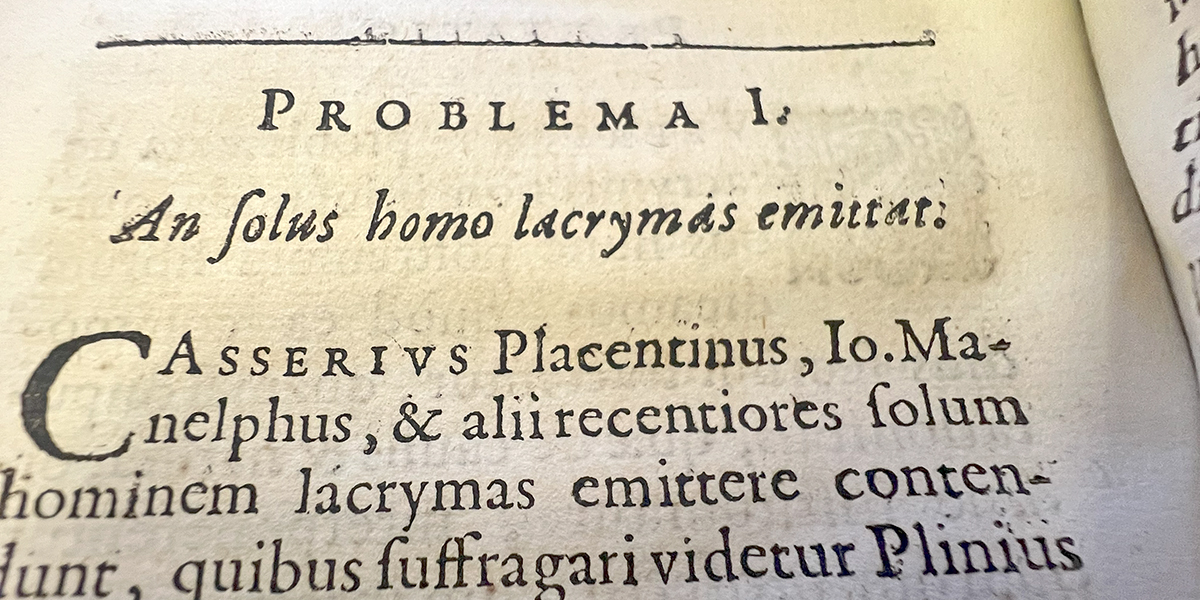
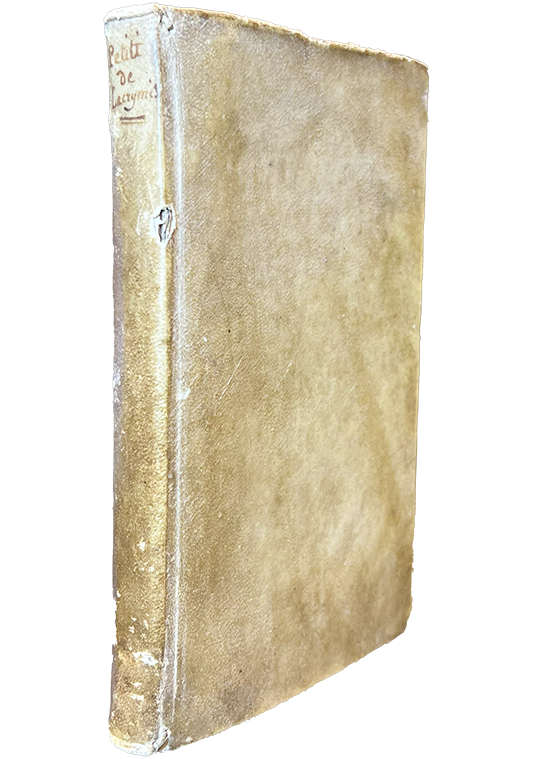
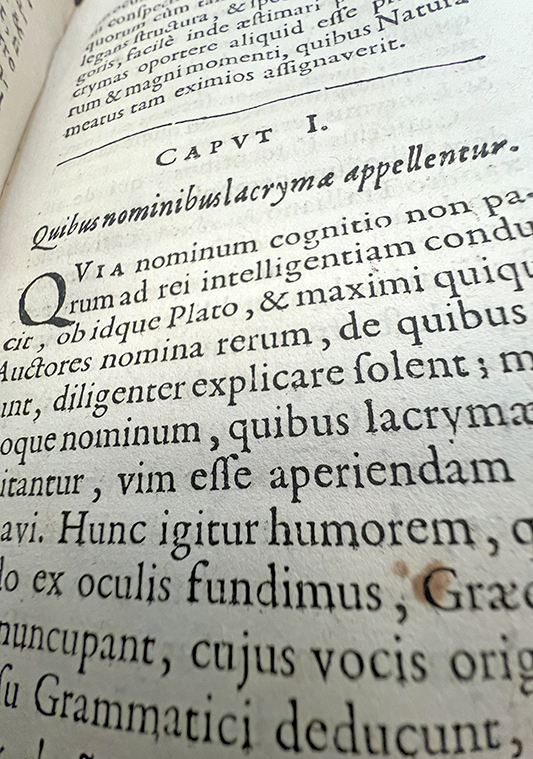
PETIT, PIERRE (1617-1687). De lacrymis libri tres. Printed in Paris by Claude Cramoisy, 1661. 18 cm tall.
Pierre Petit, born in Paris in 1617, earned his medical degree in Montpellier but chose a literary career instead of practicing medicine. He wrote about medical topics like tears and blood transfusion and compiled medical case histories. His interests also included natural phenomena and ancient myths, leading him to write about topics like tea and Amazons, reflecting his love for Greek and Latin classics. Petit even wrote Latin poetry.
His main work, De lacrymis, analyzed tears from philosophical, medical, and emotional perspectives, citing ancient authors and modern thinkers, including critiques of Descartes. The first two sections are based on Aristotelian "causes"—the material cause, causal agent, and final cause [purpose] of tears and crying—and the third and last section is a separate part discussing historical and medical problems related to the nature and physiology of tears.
Most interesting is Petit's discussion of the psychology of emotion behind crying, including a summary of the sorts of people who are prone to it. His essential thesis was that good people cry and bad people don't. Petit recognizes exceptions, though, citing Socrates, Diogenes, and Heraclitus, who supposedly never cried, and certain tyrants who cried all the time.
De lacrymis wasn't the first book on the subject and was later overshadowed by discoveries about the lacrimal glands by Nicolaus Steno, as well as Martin Cureau de la Chambre's writings on emotions. However, it remains an important historical document on tears.
Our copy of De lacrymis was in the collection of Pierre Daniel Huet, with his bookplate pasted in