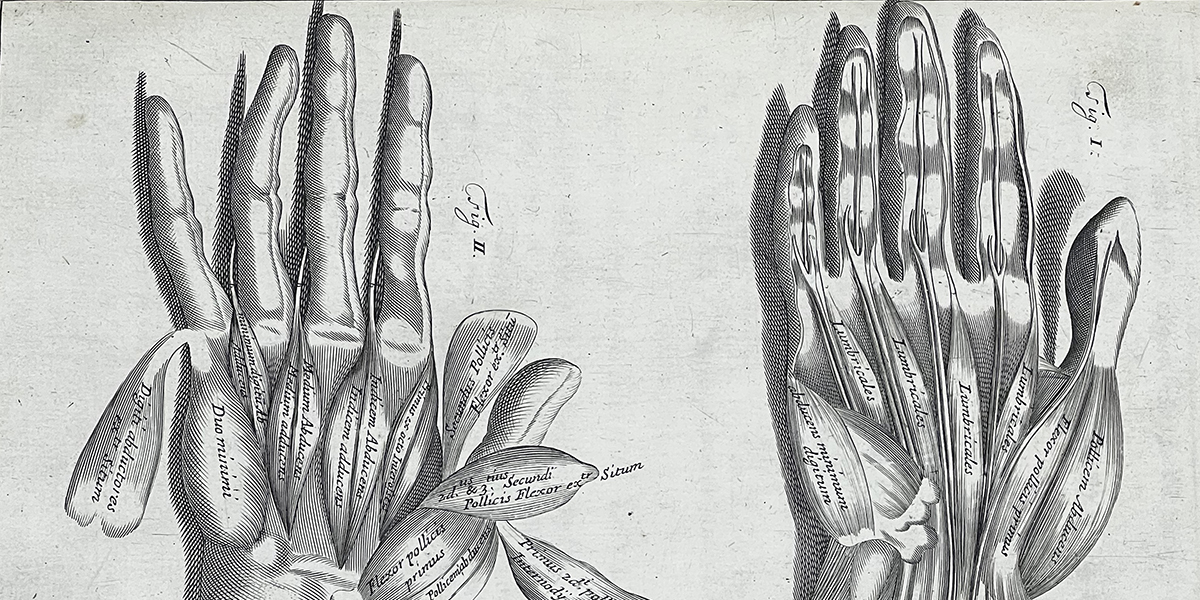
Friends of the John Martin Rare Book Room

Stolen Hearts

Damien Ihrig, MA, MLIS
Curator, John Martin Rare Book Room
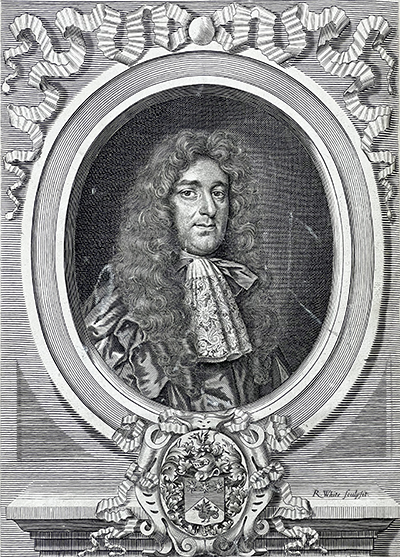
 

Black and white illustration of John Browne in a white wig from Browne's A compleat treatise of the muscles..., 1681.Hey folks. Happy February! As a month often associated with love, February is filled with heart-shaped imagery (and chocolate!). I decided to embrace this concept and go with the flow. This month, I open the valves and highlight a book that will get your pulse racing. A book with a little beat of something for everyone - anatomy, royalty, surgeons, intrigue, and wigs (and Whigs!).

John Browne (1642-1700) was a 17th-century English surgeon and anatomist. He was royal surgeon to Charles II, James II, and William III. Under Charles II, Browne first came to observe the "King's Evil," or scrofula (cervical lymphadenitis), a disease related to tuberculosis that inflames and swells lymph nodes in the neck. Some thought that the touch of royalty could heal the disease, and Charles II performed many of these ceremonies. Browne vividly described the disease and ceremonies in his Adenochoiradelogia, printed in 1684.

With a recommendation from the King, Browne was appointed a surgeon at St. Thomas's Hospital in 1683, where he trained. The Governors who oversaw the hospital, led by the Whig politician Sir Robert Clayton, disliked the freewheeling behavior of its surgical staff. The surgeons at St. Thomas felt unburdened by hospital policy because of their support by the King. However, Clayton and the Governors saw it differently and in 1691 dismissed the entire surgical staff, including Browne.

However, Browne was most well known as a serial plagiarizer and shrewd businessman. Most famously, Browne borrowed directly from the works of Giulio Casseri and William Molins for his 1675 and 1681 editions of, A compleat treatise of the muscles, as they appear in humane body, and arise in dissection. Fellow surgeon and author James Yonge heavily criticized Browne for his literary poaching.

In response, in 1697, Browne put together [deep breath...] Myographia nova, or, A description of all the muscles in humane body : as they arise in dissection : distributed into six lectures ; at the entrance into every of which, are demonstrated the muscles properly belonging to each lecture now in general use at the theatre in Chyurgeons-Hall, London, and illustrated with one and forty copper plates, accurately engraved after the life, with their names on the muscles, as much as can be expressed by figures, as also, with their originations, insertions, uses, and divers new observations of the authors, and other modern anatomists. Together, with an accurate and concise discourse of the heart, and its use, as also of the circulation of the blood, and the parts of which the sanguinary mass is made and framed, written by the late Dr. Lower, a work that exemplified his approach to writing and selling books: he made a few tweaks to A compleat treatise... and released it under a new title.

Our copy of Mygraphia nova was generously donated by Helen Hislop, an influential physical therapist who trained and practiced at the University of Iowa.

So, do not skip a beat and read more about Myographia nova below.

Stay well and happy reading!


Spring Hours

The Room is available Monday-Thursday, 8:30-5:00 (U.S. Central) and Friday by appointment. FACE MASKS ARE STRONGLY ENCOURAGED. To guarantee the Room is available, please contact me at damien-ihrig@uiowa.edu.


  Events


April 20 from 4-7 pm (central) – The John Martin Rare Book Room Open House
Join us for an evening of bibliomanic fun. Enjoy an up-close and personal look at new acquisitions and old favorites.


A color photograph showing an older caucasian male, Dr. Charles Grose, with short, white hair and a mustache. It shows his head and uppper torso, dressed in a white doctor's coat.June 6 at 7 pm (central) – The John Martin Rare Book Room Presents
Dr. Charles Grose
Professor of Pediatrics-Infectious Disease
University of Iowa Hospitals and Clinics

Details to come.


Book of the Month

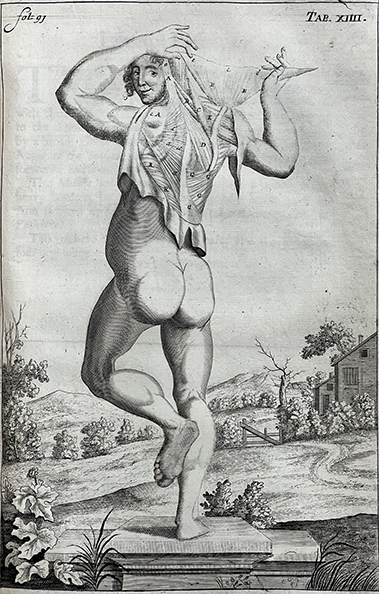
Black and white illustration of a human figure facing away from the viewer, holding up a muscle from their back, from Browne's A compleat treatise of the muscles..., 1681.

BROWNE, JOHN (1642-1700) Myographia nova, or, A description of all the muscles in humane body : as they arise in dissection : distributed into six lectures ; at the entrance into every of which, are demonstrated the muscles properly belonging to each lecture now in general use at the theatre in Chyurgeons-Hall, London, and illustrated with one and forty copper plates, accurately engraved after the life, with their names on the muscles, as much as can be expressed by figures, as also, with their originations, insertions, uses, and divers new observations of the authors, and other modern anatomists. Together, with an accurate and concise discourse of the heart, and its use, as also of the circulation of the blood, and the parts of which the sanguinary mass is made and framed, written by the late Dr. Lower. Printed by Thomas Milbourn for the author in 1697. 53 cm tall.

Browne tweaked a few things in Mygraphia nova in an attempt to distance himself from accusations of plagiarizing the works of Giulio Casseri and William Molins, most notably in the illustrations. Many of Casseri's illustrations are somewhat whimsical, with lounging poses or those with movement, with the subject of the dissection often helpfully holding back layers of skin or muscle on their own bodies.

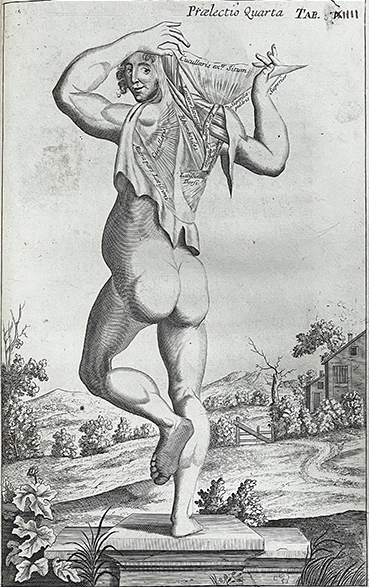
The illustrations shown here demonstrate such a pose and the kinds of small changes Browne made from A compleat treatise... (the first image) to Mygraphia nova (the second image). Browne's defenders wished to credit him with the innovation of directly labeling tissues, rather than with a letter or number referenced in the text (as can be seen in the second

Black and white illustration of a human figure facing away from the viewer, holding up a muscle from their back, from Browne's Mygraphia nova, 1697.

illustration). This too, however, was a technique lifted from others, including Casseri and Molins.

Interestingly, he added a very short section on the heart as a muscle in the 1697 edition but directed the reader to an appendix that contained the well-known work of Richard Lower. He gave Lower full credit in the title, perhaps artfully exploiting Lower's name recognition. His works were relatively popular and printed in several editions, including after his death.

The binding consists of contemporary leather with a deep brown color and a blind tooled (no color or gilt added) design on the front and back boards. It has raised spine bands with "Browne on the muscles" stamped in gilt over a red compartment on spine. The leather is quite cracked and the front and back hinges are loose, but it has been treated by our master Conservation team and is stable for use.

Other than some browning at the front and back, more than likely due to exposure to the elements and the glue on the boards, the paper is in great condition. There are a few editorial marginalia as well.

In addition to Mygraphia nova and A compleat treatise..., we also have a facsimile of the 1697 Myografia nova and Browne's collection of works describing glands, scrofula, and the King's Evil touching ceremonies.

Contact me to view this book or any others from this or past newsletters: damien-ihrig@uiowa.edu or 319-335-9154 to arrange a visit in person or over Zoom.


Facebook    Twitter    YouTube   
The University of Iowa