| Under the Covers: Mercuriale | Damien Ihrig, MA, MLIS
Curator, John Martin Rare Book Room
 Well, that was fast! February is already here, which means the semester is in full swing and the renovation of the fourth floor, including the JMRBR, is speeding into its final stages (see pictures below). As the famous philosopher Ferris Bueller once said, though, "Life moves pretty fast. If you don't stop and look around once in a while, you could miss it." So this month, even as we wrestle with the renovation and everything that goes with it, we're going to slow down for a moment to appreciate another of JMRBR's amazing works. Well, that was fast! February is already here, which means the semester is in full swing and the renovation of the fourth floor, including the JMRBR, is speeding into its final stages (see pictures below). As the famous philosopher Ferris Bueller once said, though, "Life moves pretty fast. If you don't stop and look around once in a while, you could miss it." So this month, even as we wrestle with the renovation and everything that goes with it, we're going to slow down for a moment to appreciate another of JMRBR's amazing works.
This issue is the fourth in a series looking more closely at some of our items with binder's waste.* This month's book is one some of you may recognize: Girolamo Mercuriale's most famous work, De arte gymnastica libri sex [Six books on the art of exercise]. Considered the first work on sports medicine, De arte was the culmination of Mercuriale's many intellectual passions - including medicine, language, and antiquity.
Mercuriale (1530-1606) was born into a medical family and had the opportunity to learn in some of Italy's most famous university towns - Venice, Padua, and Bologna. He was a library rat, spending many hours enthusiastically combing through the great libraries at his disposal.
His favorites were Greek and Roman works on any subject he could get his hands on. He especially enjoyed the subtleties of language, meaning, and their historical contexts.
Obtaining his medical degree from Venice in 1555, Mercuriale headed to Rome. A quick learner and excellent networker, he soon had free run of the libraries of Rome. Fourteen years later, driven by his own intellectual curiosity and the broader medical humanism of the time seeking to reconnect with classical works, he wrote De arte gymnastica libri sex.
De arte, first printed in 1569, made Mercuriale famous and opened the door to several prestigious positions. It also exposed him to criticism, especially after he misjudged a particularly horrible public health crisis.
Read below to find out more about Mercuriale and to see under the covers of his exercise on exercise.
Stay well and happy reading!
*As mentioned in a previous newsletter, I was part of a small team that presented at the June 2023 Rare Books and Manuscripts Section (RBMS) conference. Our presentation focused on the Iowa Initiative for Scientific Imaging and Conservation of Cultural Artifacts (IISICCA) and the involvement of the JMRBR. For more on the project and its scanning techniques, see the IISICCA group's article in Heritage Science.
Hours
The Room is currently under renovation. Requests for materials will be considered on a case-by-case basis. For more information, please contact me at damien-ihrig@uiowa.edu or 319-335-9154 | | 
Construction Update
Demolition is done and walls are going up!

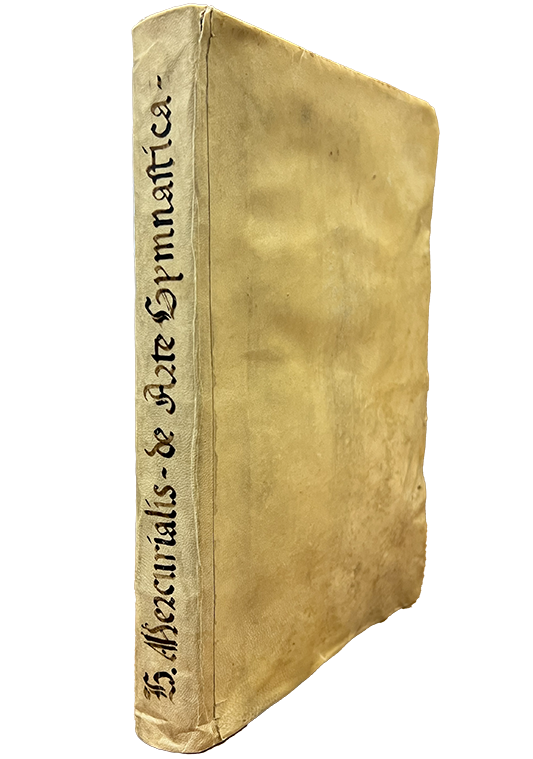
| | | | MERCURIALE, GIROLAMO (1530-1606). De arte gymnastica libri sex. Printed in Venice by the Giunti printers, 1587, third edition. 24 cm tall.
De arte gymnastica (1569) put Mercuriale on the map. Soon after it was published, he was recruited to the chair of medicine at the University of Padua. In 1573, the Holy Roman Emperor, Maximilian II, summoned Mercuriale to treat the emperor's continual health problems. The emperor was very pleased with Mercuriale's work and, although the emperor remained sick and died just a couple of years later, still conferred upon Mercuriale an imperial count palatine, a hereditary noble title.
Mercuirale returned to Padua in 1575, rejoining the faculty at the University of Padua. He wrote many books, most attempting to reintroduce his audience to classical works and connect them to contemporary practice, including De morbis cutaneis (1572), one of the earliest comprehensive, systematic treatises on skin diseases.
Although an accomplished physician, academic, and writer, Mercuriale's reputation amongst the populace took a hit when he mismanaged an outbreak of the plague in Venice. Although one of the people in charge of the public response to the illness, he insisted it was not the plague. He even promised to personally treat any sick Venetian as long as the government lifted any quarantines, which they did.
By moving amongst the sick and the healthy in every part of the city, Mercuriale and his colleagues more than likely contributed to the rapid rise in infections and deaths after they began their treatments. The government eventually halted Mercuriale's work and quarantined him and his colleagues to keep them away from the populace!
Regardless of his public reputation and clinical missteps, he remained a well-respected physician, translator, and author amongst his peers. He was a prolific writer and was recruited to several prominent (and well-paid!) positions at different Italian universities. He eventually retired to his hometown in 1606 and died soon afterward.
Mercuriale's historical pursuits were not a mere side hustle but an essential aspect of his distinguished medical career. Being a student of history was integral for 16th-century physicians. Ancient sources were often used as references for contemporary medical works. Mercuriale's writings, even when delving into antiquarian topics, were intertwined with the themes of the body and health, illustrating a vast knowledge base that extended beyond the confines of medicine.
De arte gymnastica detailed the environments and equipment used in ancient structured physical exercise. Mercuriale delved into various exercises practiced by the ancients and considered their impact on health. From a medical standpoint, Mercuriale regarded exercise as a timeless issue falling under the preservative part of medicine, responsible for | | | preventing disease, maintaining current health, and building up individuals in poor health.
Few other works on the medical benefits of exercise existed at the time. Drawing inspiration from Galen, Mercuriale's exploration of ancient athletics wasn't a straightforward endorsement or a call for revival but aimed at vividly recreating a facet of ancient culture while underlining the differences between ancient and contemporary conditions.
The book opens with a narrative about the origins of "gymnastica," linking it to the origins of medicine. While displaying extensive knowledge on the subject, Mercuriale's medical concerns influenced his interpretations, particularly in classifying gymnastica into three categories: gymnastica bellica [martial arts], gymnastica vitiosa [for competition or pleasure], and "pure" gymnastica medica [medically beneficial exercise].
He tolerated gymnastica bellica as necessary for the training of soldiers but felt gymanstica vitiosa was a degenerate practice that served no beneficial purpose. He felt gymnastica medica was where it was at if one wanted to maintain a healthy life. In addition to providing a framework for discussion of ancient exercise practices, he felt the three categories also accomplished one of his main goals when writing his books – to make ancient writings more accessible to his contemporary readers.
Despite emphasizing exercise, he cautioned against its excessive practice and provided practical medical advice akin to physical therapy. However, there is no mention of which color resistance bands he recommended.
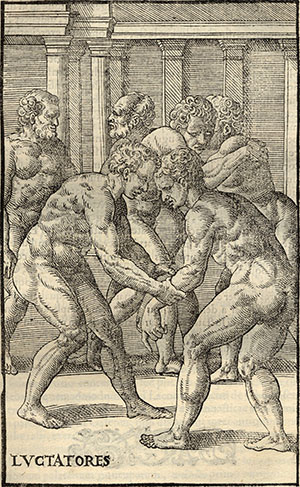
Illustrations, such as the wrestlers above, were introduced in the second edition. Although they added to the book's appeal and were a big part of its continued success, modern scholarship has shown them to be fanciful interpretations by the author and illustrator. They do stir the imagination, though, especially the illustrations of boxing "gloves." Jean Claude Van Damme would have approved.
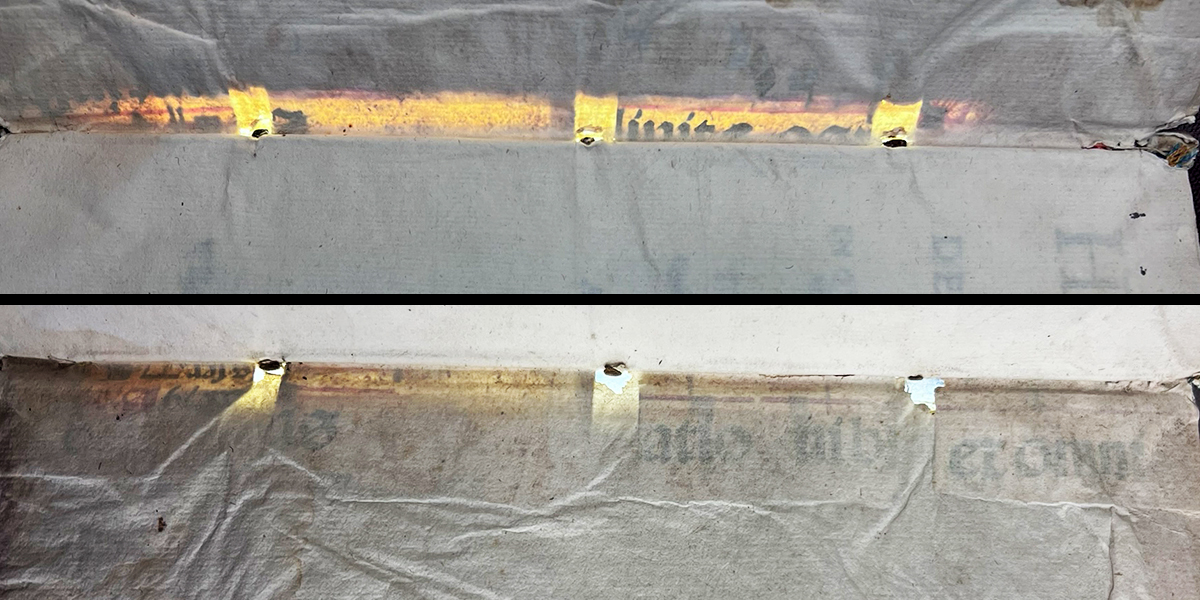
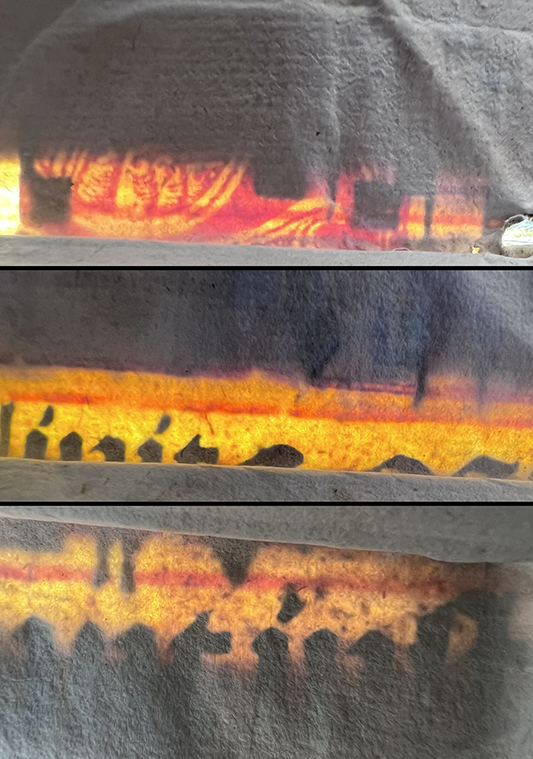
Our copy of De arte, a 1587 third edition, is in fantastic condition. The outside cover and pastedowns show the book is well-traveled but has held up well. Covered with limp vellum, shadows of dark black and bright red manuscript writing in the inside hinges give a clue as to what is hiding underneath.
The images above were obtained using a soft backlight illuminating the scraps of manuscript through the vellum cover and pastedowns. Although a lot of it is still obscured, we were excited to see evidence of more music!
Knowing the waste is there meant De arte was an excellent candidate to help calibrate the two CT scanners used for the project. The books scanned for IISICCA are still being processed, but we are excited to see what other surprises await under their covers.
Contact me to take a look at this book or any others from this or past newsletters: damien-ihrig@uiowa.edu or 319-335-9154. | | | |