| Happy New Year | Damien Ihrig, MA, MLIS
Curator, John Martin Rare Book Room
 Happy new year, dear readers! I think we can all agree that 2022 was a little weird. Perhaps that is just the new normal? Happy new year, dear readers! I think we can all agree that 2022 was a little weird. Perhaps that is just the new normal?
Embracing this new weird normal, we decided to highlight a book this month on skin and skin diseases from a 16th-century Italian anatomist known most widely for his work on reproductive organs.
Gabriel Fallopius (aka Gabriele Fallopio) had a relatively short but incredibly impactful career. The one-time priest was a physician, anatomist, surgeon, dentist, professor, and celebrated lecturer.
Although mostly known now for the eponymous Fallopian Tubes (called "oviducts" in all other mammals), the tubes in human females through which eggs travel from the ovaries to the uterus, he was known in his own time as a student of some of the most famous physicians of the time, an excellent anatomist, and for supplying corrections to the work of Vesalius.
He was enthralled by anatomy and seemingly interested in all parts of the body. This is evidenced by the number and variety of anatomical structures named after him. Beyond anatomy, he also worked with medicinal plants and has a genus in the buckwheat family named after him.
He is also credited for inventing names for many other parts (e.g., tympanum and vagina). As a physician, he is credited with creating the condom in an effort to prevent the spread of syphilis (supposedly tied off with a pink ribbon to make it more appealing for women).
Fallopius's greatest work, Observationes anatomicae, is a commentary on Vesalius's De humani corporis fabrica that attempts to correct Vesalius based on Fallopius's own observations. However, this month we highlight one of his lesser-known works on skin and skin diseases, Libelli duo, alter de ulceribus: alter de tumoribus praeter naturam [Two pamphlets, one on ulcers: the other on unnatural tumors].
Fallopius died at the (very young!) age of 39, most likely from tuberculosis. Although he practiced for less than twenty years, his impact on medicine - especially anatomy - was immense. Read more below about one of the 16th-century masters of medicine and this often overlooked work.
Happy New Year, everyone, and happy reading! Let's get weird!
Hours
The Room is available Monday-Thursday, 8:30-5:00 (U.S. Central) and Friday by appointment. Face masks are welcome and available for free to all visitors. To guarantee the Room is available, please contact me at damien-ihrig@uiowa.edu or 319-335-9154. | | | | FALLOPIUS, GABRIEL (1523-1562). Libelli duo, alter de ulceribus: alter de tumoribus praeter naturam [Two pamphlets, one on ulcers: the other on unnatural tumors]. Printed in Venice by Donato Bertelli, 1563. 101 pages. 21 cm tall.
Fallopius was born in 1523 in Modena, Italy, to a lower noble family. The death of his father and financial troubles forced him into the priesthood before he could finish his university studies. This was an inherited position in his family and there is some question as to whether or not he actually practiced. He turned to performing surgery to help earn money, although indications are he did not enjoy it.
By 1545, Fallopius was enrolled at the University of Ferrara, studying medicine at one of the best medical schools in Europe. Reading about Fallopius is a bit like playing six degrees of separation. Except, instead of involving Kevin Bacon (an award to anyone connecting Fallopius and Kevin Bacon in six steps or less!), it connects all the major physicians and surgeons of the 16th and 17th centuries.
He studied with, worked with, taught, and inspired many well-known physicians during and after his life. At Ferrara, he worked most closely with the famous Italian physician Antonio Musa Brasavola. You may remember Brasavola from Dr. Jonathan Reeder's presentation this past October.
Fallopius eventually moved to the University of Pisa to complete his medical education. Upon completing his studies, he stayed on as a lecturer at Pisa. He also continued to study with other masters, including Giovanni Battista Da Monte (aka Johannes Baptista Montanus) and Matteo Realdo Colombo at the University of Padua.
He is often referred to as a pupil of Vesalius, also at Padua. Although a friend and colleague of Vesalius, it is not believed he was a literal pupil of the famous anatomist. This can be traced to a misinterpreted translation of Fallopius in which he stated he was "a student of Vesalius."
He eventually succeeded Colombo as the Chair of Anatomy, Surgery, and Botony at Padua. Colombo had previously replaced Vesalius while he was away in Basil, overseeing the publication of the Fabrica.
Fallopius's Observationes anatomicae, a modest work funded with his own money and without illustrations, attempted to correct the Fabrica based on Fallopius's own observations during dissections. Vesalius did not take kindly to this and attempted to publicly discredit his friend. He was ultimately unsuccessful. | | | Fallopius was a revered professor and lecturer who inspired his many students to continue to challenge the status quo through direct observation. Many of his works, including the one highlighted in this newsletter, were published by his students after his death in 1562.
Libelli duo... is a treatise on diseases of the skin, focusing on ulcers and tumors. It is one of the most thorough works of its kind up to the time of its publication.
Fallopius not only describes the illnesses and their various presentations but also innovations in treatment. He suggests new techniques for the cauterization of ulcers and the removal of tumors.
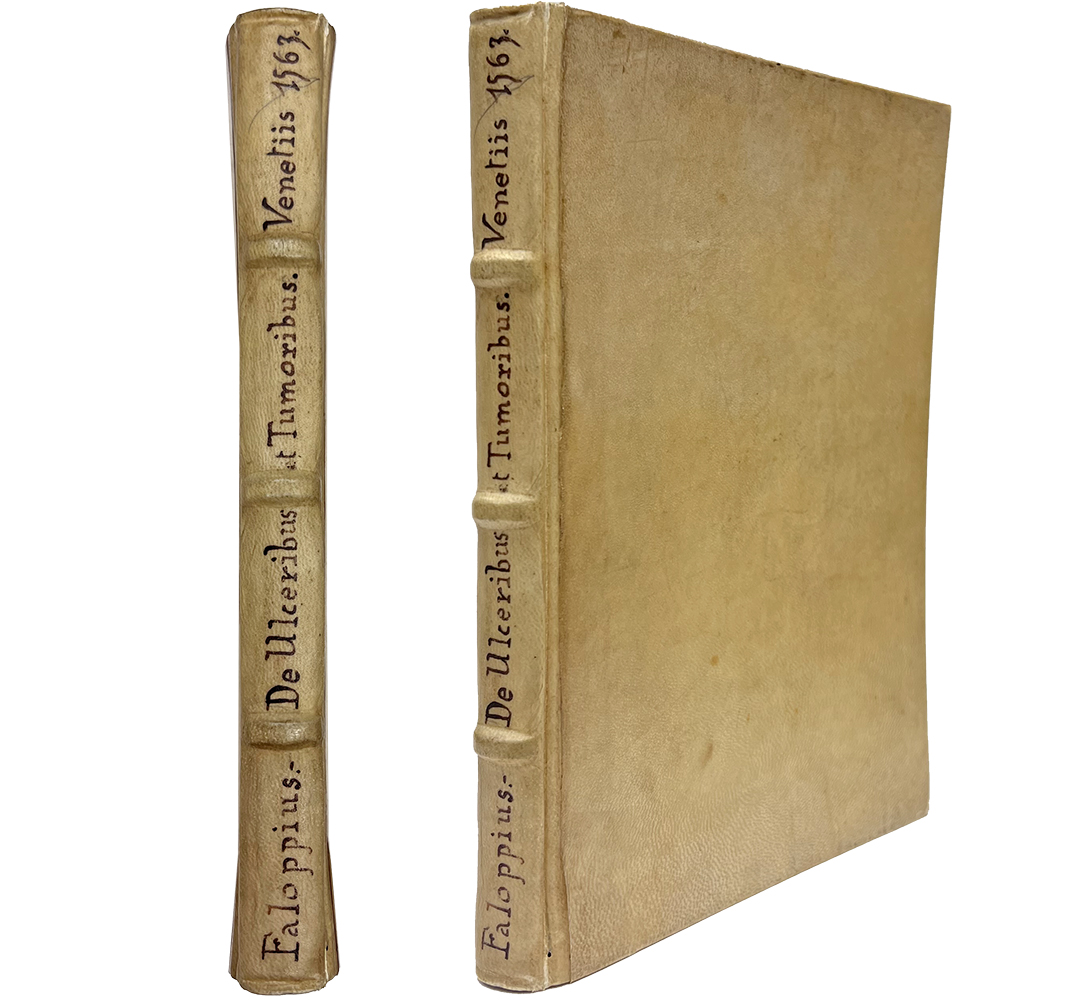
The book shows many interesting material and bibliographical elements. It is covered with a limp vellum, aged to a warm yellow with no major damage. It has been rebacked, though, with new vellum and a carefully hand-lettered spine title.
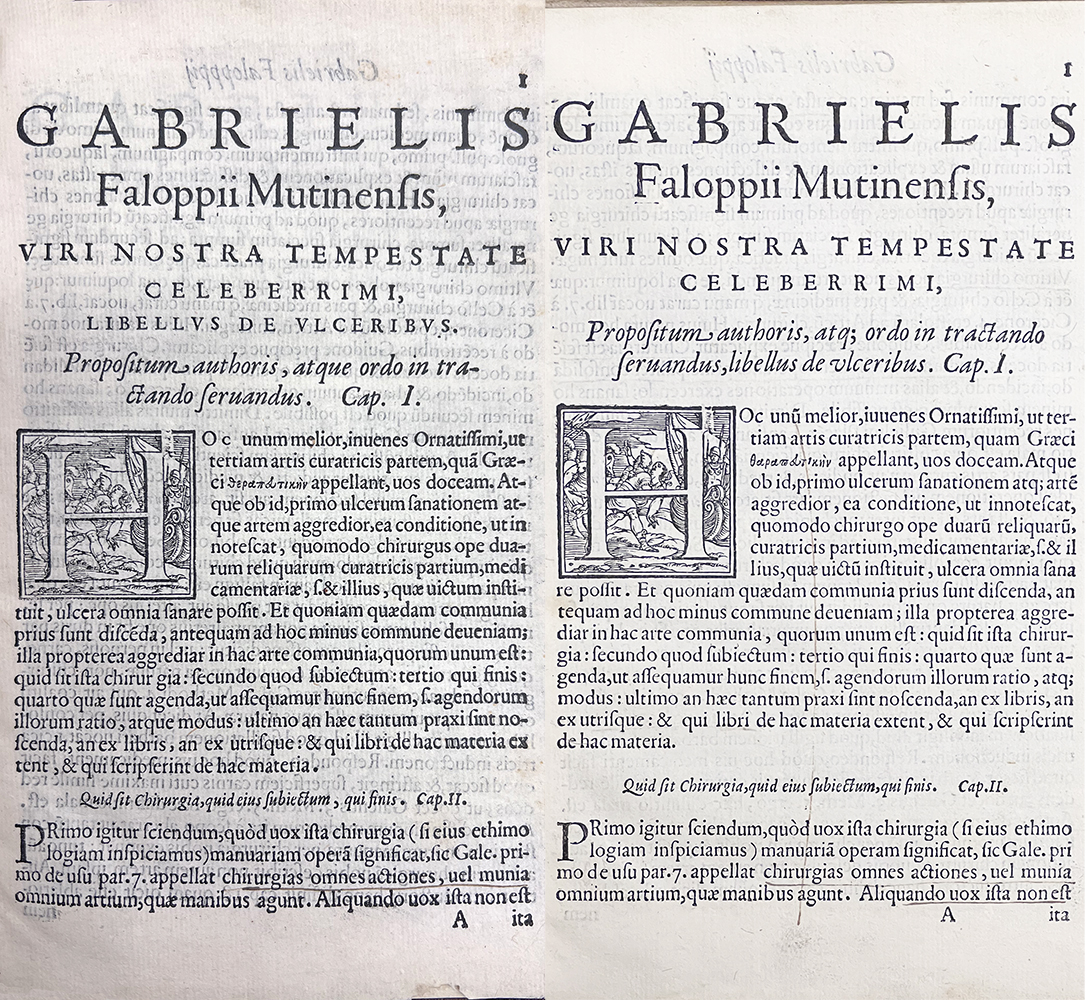
The first leaf of the book looks like it was meant to be canceled (replaced with a corrected leaf), but instead, the new leaf was added and the old leaf was retained. This is somewhat unusual and very handy for folks studying the creation of this particular edition and book production, in general, at that time.
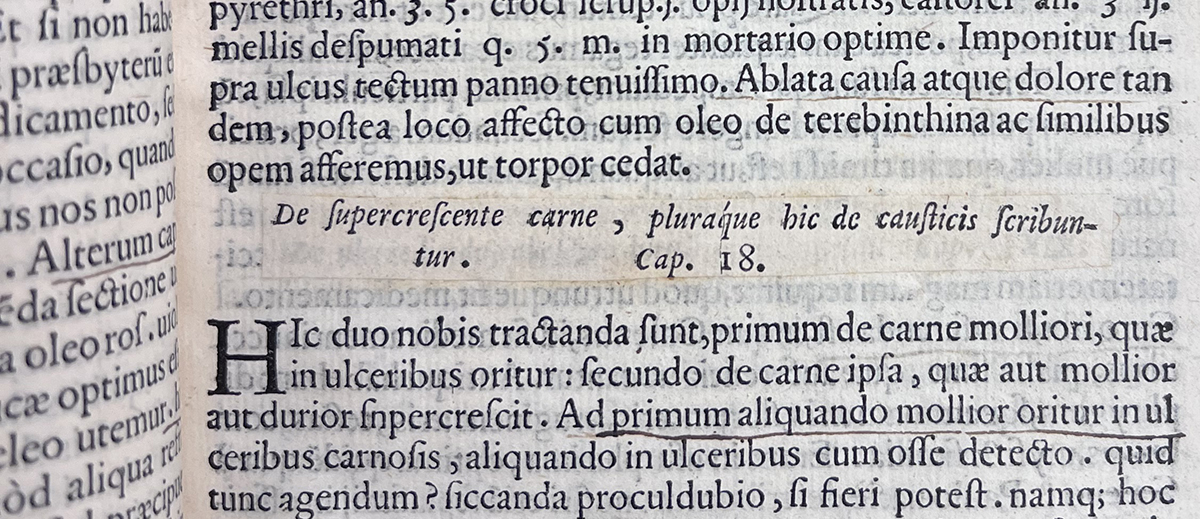
The book is broken into chapters, several for each main topic. As can be seen in the banner image above, chapter 18 of the ulcers topic was corrected by pasting a new chapter heading over the old one. Unlike the canceled first leaf, though, this is not unique to this volume. The new chapter 18 heading can be seen in multiple digitized copies.
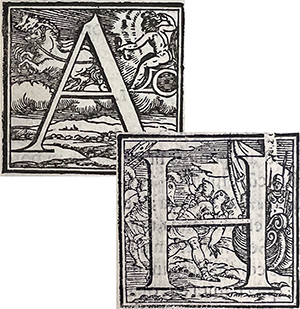
Interestingly, the chapter headings use an inconsistent mix of Roman and Arabic numerals. For example, chapter 18 above uses Arabic numerals, but chapter 17 uses Roman. The two section headings (three in our edition because of the canceled leaf) use delightfully illustrated initials showing classic scenes. They can be seen in the introduction above.
Finally, the book has clearly been well cared for. It is in great condition and filled with marginal notes by a careful reader. It is another great example of these beautiful artifacts that combine the history of medicine, early book production, readership, and conservation practices!
Contact Damien Ihrig to view this book or any others from this or past newsletters: damien-ihrig@uiowa.edu or 319-335-9154 to arrange a visit in person or over Zoom. | | | |