Damien Ihrig, MA, MLIS
Curator, John Martin Rare Book Room
_(cropped)_wikimedia.jpg) Welcome to January, friends. As you sit in front of your full-spectrum light, sipping hot cocoa, you no doubt begin to make note of the overlap between psychiatry and the world of cats. And the biggest name to come out of this thinnest of Venn diagrams is Johann Christian Reil (1759-1813).
Welcome to January, friends. As you sit in front of your full-spectrum light, sipping hot cocoa, you no doubt begin to make note of the overlap between psychiatry and the world of cats. And the biggest name to come out of this thinnest of Venn diagrams is Johann Christian Reil (1759-1813).
Reil, seen here auditioning for the role of Dracula, was an 18th-century medical multihyphenate: physician-anatomist-physiologist. He was also the first true psychiatrist by virtue of coining the term "psychiatry" (or "psychiatrie" in German). His contributions to anatomy include the first description of the arcuate fasciculus in 1809 and the identification of anatomical features such as Reil's finger (later known as Raynaud syndrome) and the Islands of Reil in the cerebral cortex.
Reil's philosophical perspective on mental illness evolved in the context of the Romantic movement, blending scientific inquiry with a deeper appreciation of life's poetic and tragic aspects. In 1803, Reil published Rhapsodieen über die Anwendung der psychischen Kurmethode auf Geisteszerrüttungen [Rhapsodies on the Application of Psychological Methods of Cure to the Mentally Disturbed], a seminal work that significantly influenced German psychiatry before Sigmund Freud. Not a one-hit wonder, Reil was also an active editor and orchestrated several medical journals, including two devoted to psychiatry.
Rhapsodieen is characterized by its rich metaphors and ironic tone, which stood apart from typical medical treatises of the time. In it, he proposed indirect psychological methods to treat mental illness, emphasizing the role of social conditions and the harmony of the mind's functions. Reil often proposed ways to shock the system for patients with dissociative-type or catatonic disorders. His hypothesis was that the shock would jolt the patient and bring them back to conscious awareness.
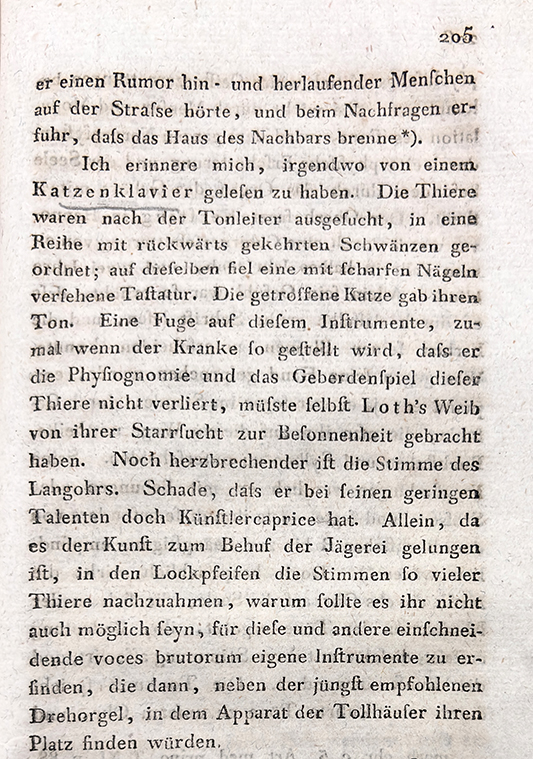
One such method he suggested was the use of the katzenclavier, or cat piano (see illustration above). The idea of the cat piano predates Reil by several centuries, but it is a fairly simple, if horrific, concept. It consists of several boxes in a row, each with a small hole in the back. Kittens are placed in the boxes, one each, in order of the key of their yowl. A small keyboard connected behind the boxes allows the player to push on the keys, which in turn lowers a small rod with a nail sticking out of it. The nail hits a kitten's tail, producing the requisite yowl.
I cannot stress this enough—there is no evidence a cat piano (or cat organ as it is also called) was ever built. Thankfully. But such a fanciful idea appealed to Reil's romantic sensibilities and theories of psychological shock.
This month, we highlight the 1818 second edition of Rhapsodieen über die Anwendung der psychischen Kurmethode auf Geisteszerrüttungen. Read below right meow to learn more about Reil, his psychological theories, and our copy of Rhapsodieen.
Stay warm and happy reading!
Hours
The JMRBR is open to the public from 8:30 a.m. to 5 p.m. Monday through Thursday and by appointment on Friday. For more information, please contact me at damien-ihrig@uiowa.edu or 319-335-9154.

![Color photograph of a black and white illustration of a Katzenklavier [cat piano] from La Nature, 1888.](https://dispatch-cdn.its.uiowa.edu/library.hardin/c/1380630032/reil_rhapsodieen_u_ber_die_anwendung_1818_banner1.jpg)