Friends of the John Martin Rare Book Room

Don't go chasing watermarks

Damien Ihrig, MA, MLIS
Curator, John Martin Rare Book Room

Happy summer, everyone! As you may have noticed, it's hot out. But there are also so many things in bloom right now it's hard not to go out for the occasional stroll and soak in all the wonderful gardens. So, it made sense that this special (long!) double issue of the newsletter was supposed to be all about plants. The books had other ideas.

It will still be about plants, but it will also be about some other fun finds. If that sounds mysterious, don't worry, keep reading. It will grow on you.

Besides getting to share items from this amazing collection with you, the best part about making these newsletters is that I get to learn so much about the items in this amazing collection. And every now and again, there's something about the book of the month that draws me into a research rabbit hole. This month, that book is Flora de filipinas (1837) by Manuel María Blanco Ramos (1779–1845) and the rabbit hole involves watermarks.

Watermarks are a combination of shapes, letters, and symbols visible in handmade paper when light passes through it. They were used as a way of identifying the paper mill, much as logos are used on products today, or to identify the size of a full sheet of paper.

Papermakers used fine mesh screens to create individual sheets of paper. They used the screens to scoop chewed-up fibers from a water bath. As the water drained, the fibers would come to rest on the screen. The matted sheet of fibers was then dumped out, pressed to release more water, and dried.

To create a watermark, papermakers would sculpt shapes, letters, or symbols out of wire and attach them to the screen. Because the sculpted wire pushed against the matted fibers, it created an impression of the wire's shape slightly thinner than the surrounding fibers. When the sheet driedvoilà!the shape was visible when light passed through the paper.

Flora de filipinas is one of our newest acquisitions. It is the first edition of a famous botanical work by the 19th-century Spanish Augustinian friar Manuel Blanco. Blanco's goal was to create a comprehensive work describing the plants of the Philippines. He took his task very seriously—it is a very thick book! So thick that as I looked it over, I wondered if all the paper used in its construction came from the same papermaker. Thus began my descent down the watermark rabbit hole.

Read below to learn more about Blanco, Flora de filipinas, and the watermarks within.

Stay well and happy reading!


Hours

The JMRBR is open to the public from 8:30 a.m. to 5 p.m. Monday through Thursday and by appointment on Friday. For more information, please contact me at damien-ihrig@uiowa.edu or 319-335-9154.


Roots of Medicine

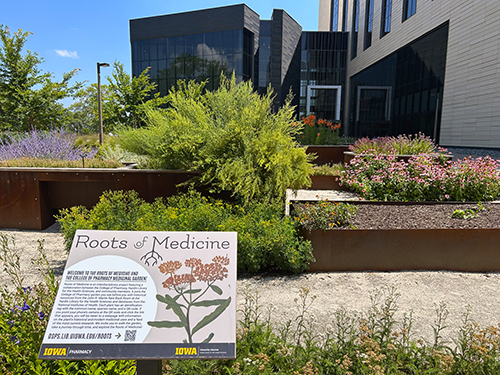
UI College of Pharmacy Roots of Medicine Garden is in bloom!
Map

Need a fun place for a lunch break? Haven't had a forest bath in a while? Just need to test out new allergy meds? Stop by the Roots of Medicine Garden at the UI College of Pharmacy!

Roots of Medicine is an interdisciplinary project featuring a collaboration between the College of Pharmacy, Hardin Library, and community members. It joins the College of Pharmacy garden with historical resources from the JMRBR and databases from the National Institutes of Health. Each plant has an identification tag with the common name and species name and a QR code that connects to a webpage with information on the plant’s historical and modern medicinal uses and a feed of the most current research.

See you there!


Book of the Month

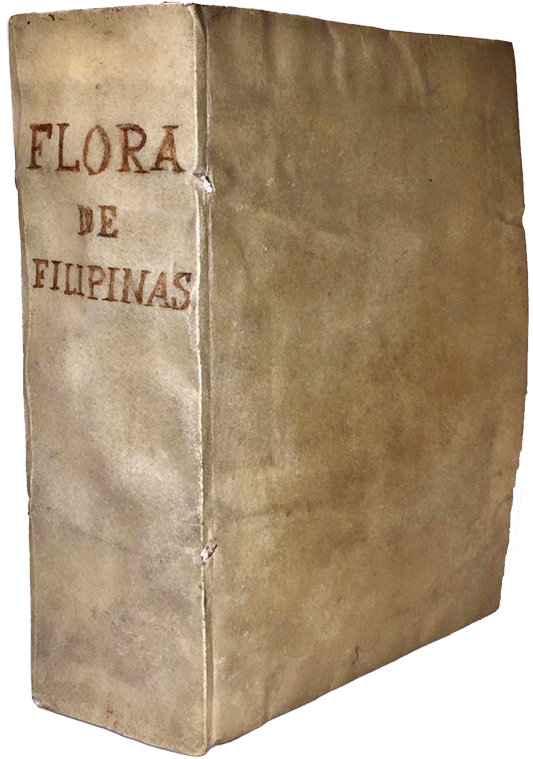
BLANCO, MANUEL (1779–1845). Flora de filipinas. Printed in Manila at the Santo Tomas press, 1837. 21 cm tall.

Manuel María Blanco Ramos was born on Nov. 24, 1779, in Navianos de Alba, a small village in the province of Zamora, Spain. Blanco grew up in Spain, influenced by King Charles III's commitment to humanism and scientific progress. Despite the turbulence of the 19th century, Blanco emerged as a prodigious figure driven by a desire to serve his parishioners and explore the natural world.

At the age of 10, Blanco entered the College-Seminary in Valladolid, where he studied Latin and philosophy. His thirst for knowledge extended beyond theology; he immersed himself in various scientific disciplines, including chemistry, physics, natural history, mathematics, geography, and astronomy.

After completing his Augustinian training in 1804, Blanco left for the Philippines. Arriving in Manila in 1805, the local Catholic parish assigned him to a monastery in the town of Angat in the province of Bulacan. His primary task was to learn the Tagalog language under the guidance of Brother Joaquín Calvo, who shared Blanco's passion for plants.

In 1822, he translated Tissot's Treatise on Domestic Medicine from French to Tagalog. His goal was to incorporate locally available remedies, bypassing those inaccessible to the indigenous population. Given the abundance of local vegetation, he focused on indigenous plants with healing properties.

Blanco meticulously observed the country's vegetation. He collected plant specimens, took notes, and documented his findings. He lacked formal training as a professional botanist and had no mentors or herbaria for reference. Armed only with Carl Linnaeus's System Vegetabilium and later Jussieu's Genera Plantarum, he embarked on a quest to catalog every plant in the Philipines.

His work culminated in the monumental work Flora de Filipinas, según el sistema sexual de Linneo [Flora of the Philippines according to Linnaeus's system]. This comprehensive work cataloged over 900 plant species, providing valuable insights into Philippine botany.

Father Blanco included common names in Tagalog, Bicol, Visayan, Ilocano, and Pampango alongside scientific nomenclature. Observations included medicinal and practical applications.

Although initially reluctant to publish his work, his fellow friars eventually convinced him that his book would significantly contribute to the scientific understanding of the Philippines. The book proved to be very popular and Blanco soon started work on a slightly expanded and improved second edition. Unfortunately, he would not finish the book before his death.

Blanco spent the final years of his life in poor health due to a prolonged bout of dysentery. He

died on April 1, 1845, at the age of 66.

He had worked diligently on his expanded and corrected second edition and it was nearly complete. His fellow friars finished the book and printed it later that year.

Although Blanco's herbarium collection no longer exists, Flora de Filipinas remains a testament to his passion for botany and for providing useful medical information to the people of the Philipines.

Our copy of Flora is covered in limp vellum, with the title handwritten on the spine. It is, in modern parlance, chonky—it stands only 21 centimeters tall but is almost 900 pages long! Most of the paper is good quality and sturdy, and although it appears the book may have been resewn and the pages possibly washed, the cover is contemporary with the printed text.

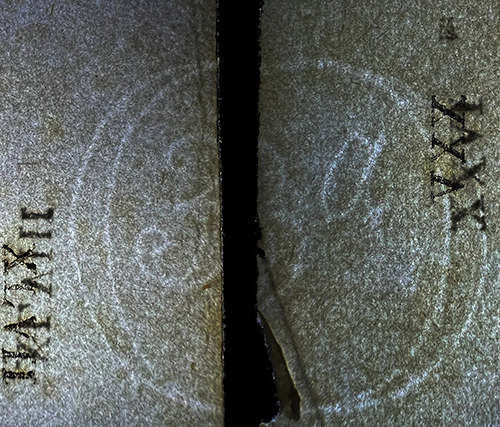
The pages of the book also contain the many watermarks mentioned before, possibly from as many as nine separate papermakers. Examples are strewn about this issue.

Identifying watermarks can be a bit tricky. Some are well-documented and we know exactly who they belong to. Thanks to the Filigranas Hispánicas watermark database and other watermark databases, I could identify the following watermark as Roman Romani, an 18th-century family of papermakers in Málaga, Spain.

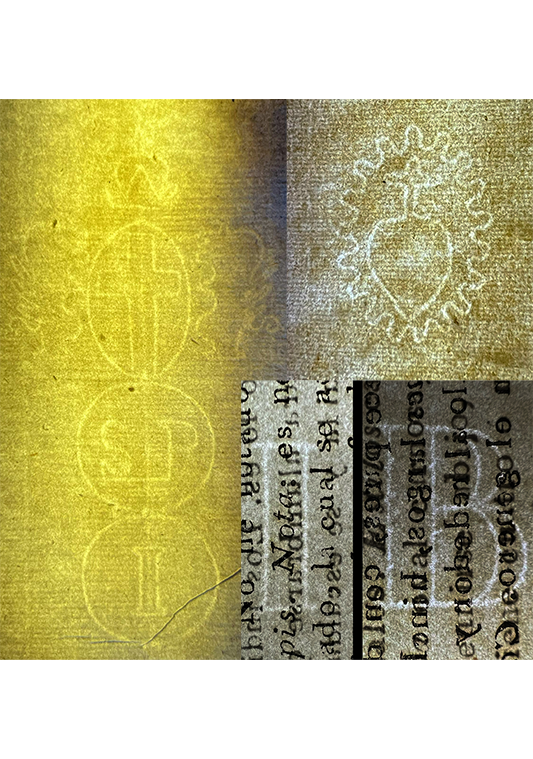
I got lucky, though, because the Romani's signed their work with their full name. Many watermarks are not so straightforward. The heart you see above is cataloged in a few different places, but I could not find who it belongs to.

The tall mark on the left above is a good example of a variation on a theme—three circles, initials for the papermaker, and topped by the Genoese coat of arms (two griffins on either side of a cross topped by a crown). The Republic of Genoa in Italy was a major European hub for papermaking and mercantile shipping, so there are a lot of examples of this style of watermark.

Unfortunately, I haven't yet identified which mill the initials SP correspond to. Same with the M with the vine beneath it in the header and the 3a and IB watermarks above. But the search is the fun part!

Contact me to take a look at this book or any others from this or past newsletters: damien-ihrig@uiowa.edu or 319-335-9154.

Facebook    Twitter-X    YouTube   
The University of Iowa