In Like a Lion's Tail, Out Like a Lamb's Ear
|
Damien Ihrig, MA, MLIS
Curator, John Martin Rare Book Room
 Spring has sprung! Or it soon will, anyway. As the last of the snow fades in Iowa (fingers crossed!), I am filled with a renewed optimism. The greening of the landscape is always inspiring, but especially so this year. Layering a dark, cold, and messy winter on top of an already challenging pandemic has heightened our need for the refreshment of spring, a reconnection with nature, and an escape from our quarantine abodes. Spring has sprung! Or it soon will, anyway. As the last of the snow fades in Iowa (fingers crossed!), I am filled with a renewed optimism. The greening of the landscape is always inspiring, but especially so this year. Layering a dark, cold, and messy winter on top of an already challenging pandemic has heightened our need for the refreshment of spring, a reconnection with nature, and an escape from our quarantine abodes.
And speaking of nature, I have had the good fortune over the winter months to work with our collection of herbals, or medicinal plant books. One of the great things about being at a place like Hardin Library, and the University of Iowa, is the opportunity to engage in interdisciplinary programs and projects. The Roots of Medicine project is a collaborative effort between librarians at Hardin and the College of Pharmacy administration, in conjunction with the construction of the College's new building. Spearheaded by former Hardin librarian, Liz Kiscaden, and brought to life through the contributions of many others at Hardin, the UI Libraries, Pharmacy, and the community - including my predecessor, Donna Hirst - The Roots of Medicine represents a truly collaborative project that brings together nature, the health sciences, history, and technology. You will hear more about the project in the coming months in this newsletter, but I also encourage you to attend a presentation on the project to the Iowa Bibliophiles on the evening of April 14.
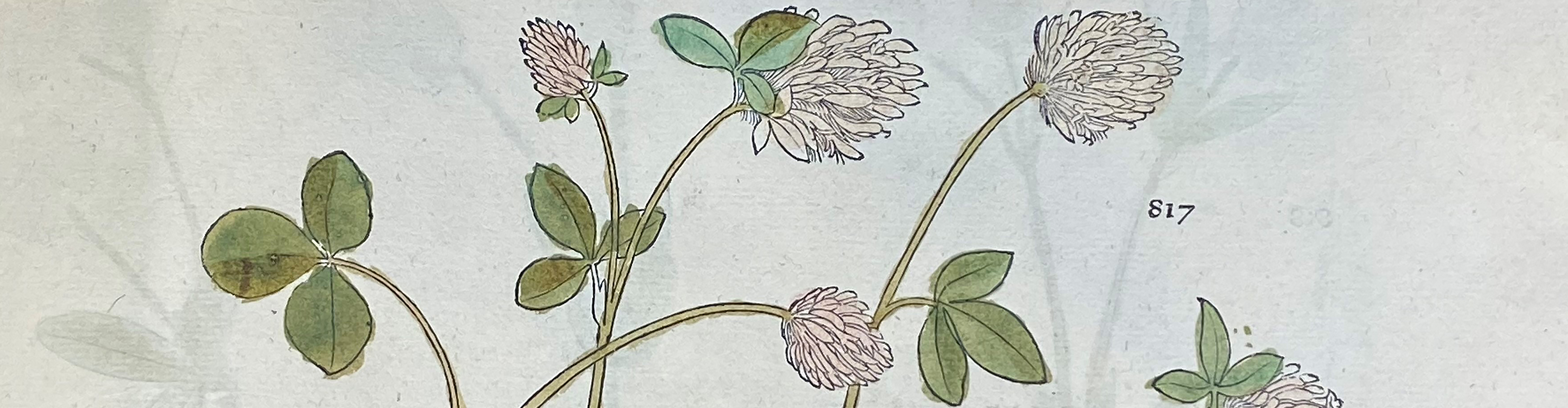
More information on that presentation is below. My role in this project has been small, but having the opportunity to work with the herbals, key sources of historical information and images of medicinal plants, made those long winter months a little brighter. Two of those herbals are Leonhart Fuch's important De historia stirpium commentarii insignes, providing the lovely banner image of clover above, and Adam Lonicer's Kreuterbuch, kunstliche Conterfeytunge der Bäume, Stauden, Hecken, Kreuter, Getreyde, Gewürtze..., March's book of the month below. As an added treat this month, Rare Materials Cataloger, Duncan Stewart, also gives us a bit of insight into how a book like Lonicer's makes its way into the library catalog. Our herbals are not only valuable sources of information but can also be beautiful works of art. And they make me look forward to spring and summer and seeing the fruits of our labor blossom in The Roots of Medicine.
Stay well, get outside, and happy reading!
|
The Rare Book Room is open! We can accommodate one researcher/visitor at a time.
Please make an appointment by contacting Damien Ihrig at damien-ihrig@uiowa.edu.
|
|
|

You cannot judge a book by its cover.
The title page is another story.
Duncan Stewart, MA, MLS
Rare Materials Cataloger, University of Iowa Libraries
Adjunct Faculty, UI School of Library and Information Science
The John Martin Rare Book Room is filled with books of great medical historical value. But do you know how all those books get into the JMRBR? A book's journey to the Rare Book Room may start as a donation or as a purchase from a rare book dealer. After being physically recorded as a new part of the collection, all books travel next to one of the University of Iowa Libraries' rare book catalogers.
Catalogers ply their trade buried within library technical services departments. There they pore over uncatalogued books, comparing the book in hand to its donor or vendor descriptions, taking note of authors, how the leaves of paper were printed and bound, recording how many pages and illustrations there are, and spotting errors that make that book unique. Then catalog librarians weave these disparate threads of information into a single tapestry in the online catalog enabling scholars and other library patrons to discover a new and unique addition to the collection. A full essay on all aspects of cataloging rare books would be long and probably stupefying. However, this title page from a 16th-century herbal work on medicinal plants illustrates one step of rare book classification.
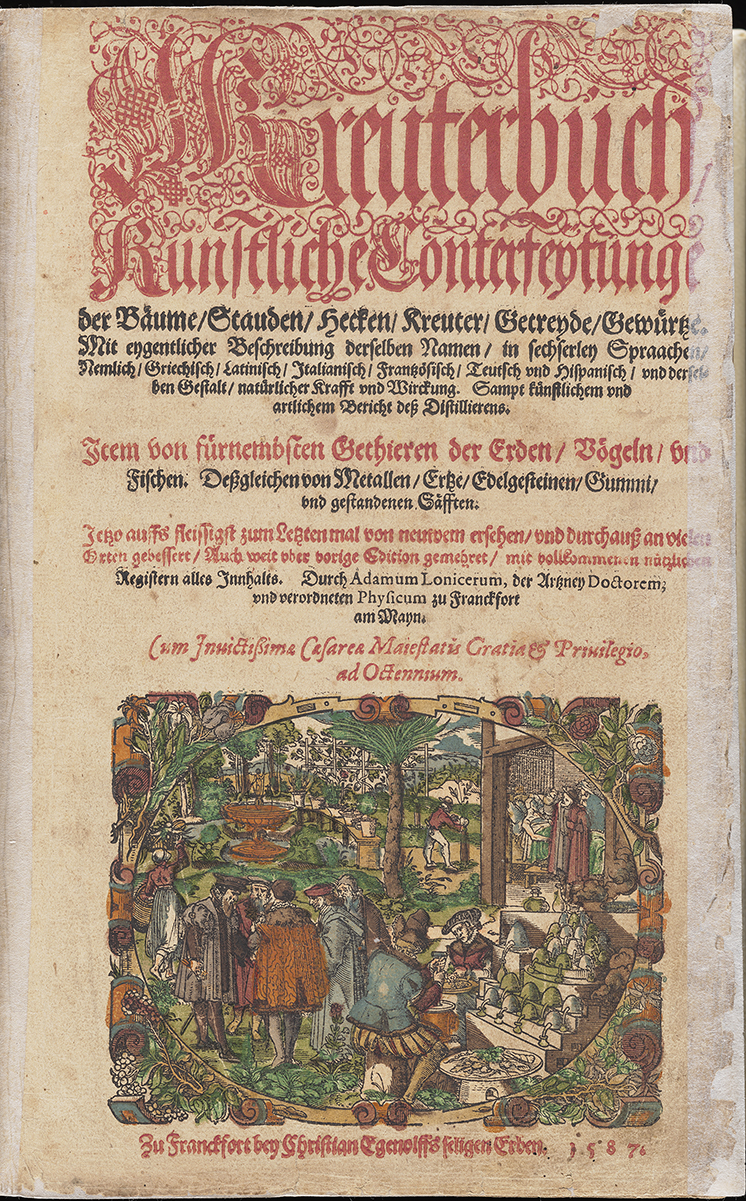
The full title is:
Kreuterbuch, kunstliche Conterfeytunge der Bäume, Stauden, Hecken, Kreuter, Getreyde, Gewürtze : mit eygentlicher Beschreibung derselben Namen, in sechserley Spraachen, nemlich Griechisch, Latinisch, Italianisch, Frantzösisch, Teutsch und Hispanisch und derselben Gestalt, natürlicher Krafft und Wirkung. Sampt künstlichem und artlichem Bericht des Distillierens. Item von fürnembsten Gethieren der Erden, Vögeln, und Fischen, dessgleichen von Metallen, Ertze, Edelgesteinen, Gummi, und gestandenen Säfften. Jetzo auffs fleissigst zum Letzten mal von neuwem ersehen, und durchauss an vielen Orten gebessert, auch weit über vorige Edition gemehret, mit vollkommenen nützlichert Registeren alles Innhalts / durch Adamum Lonicerum
Or loosely translated into English from 16th-century German:
Herbal book, an artful representation of trees, shrubs, hedges, herbs, grains, and spices. With detailed description and their names in six different languages, Greek, Latin, Italian, French, German, and Spanish, and with descriptions of their physical appearance, natural strength, and effects. Artfully collected into a report on distilling. As well as information about the most important animals of the earth, birds, fish, metals, ores, precious stones, saps, and juices. Now seen in greater detail than the previous edition, greatly improved, with useful tables of contents / by Adam Lonitzer.
The title page does not provide all the information needed, such as the number of pages, printing technique, or binding method, But the lengthy title conveys what the book is about, as well as where, when, and who created it. It also contains a wealth of information to begin an online catalog record. Details like the author’s name, which will be one way to find this book in the catalog. The details in the title help the cataloger determine subject headings to describe the book’s contents. And create a call number. The place, printer, and date at the foot of the title page offer details of book production in the western part of Germany in the late 16th century. The woodcut print demonstrates the intricate carving and laborious hand coloring lavished on illustrations in this text.
The title page printed in red and black, the luxurious decoration, and the Gothic script all serve notice that this book is one of some importance. Also, the woodcut illustration depicts an image of men at work, especially in the important economic activity of distilling in Frankfurt am Main, which continues to this day. Thus, the title page is the foundation for the catalog record below.
| Title |
Kreuterbuch,... |
| Author |
Lonicer, Adam 1528-1586 |
| Subjects |
Botany -- Pre-Linnean works |
| |
Natural history Botany, Medical -- Early works to 1800 |
| |
Medicinal plants |
| |
Herbals |
| |
Herbs |
| |
Distillation |
| |
Materia medica |
| |
Vellum bindings (Binding) |
| |
Encyclopedias -- Germany -- 1587 |
| Description |
Binding: Modern vellum over pasteboard, raised bands, black and red morocco labels |
| |
First published in Latin under title: Naturalis historiae opus novum. |
| |
Foliated with pages numbered on recto |
| |
Signatures: )(⁶ 3*⁴ 2*⁴ A-O⁶ P⁴ Q-Z⁶ a-z⁶ 2A-2E⁶ 2F⁴ 2A-2M⁶ 2N⁵ |
| |
"Five large and 13 small woodcut vignettes, and hundreds of woodcuts of plants, flowers, fruits, animals, minerals and gems, all with contemporary hand coloring."--Vender catalog |
| |
Title printed in red, guide words throughout |
| |
Includes indexes |
| |
References: Pritzel (2nd) 5599 |
| Publisher |
Zu Franckfort : Bey Christian Egenolffs seligen Erben |
| Creation Date |
1587 |
| Format |
14 unnumbered pages, CCCLXXXII, 3 unnumbered leaves : color illustrations ; 31 cm |
| Language |
German |
| Additional title |
Naturalis historiae opus novum |
April 14 at 7:00 PM (central) – The John Martin Rare Book Room Presents & Iowa Bibliophiles
The Roots of Medicine
As winter fades in Iowa and the landscape begins the welcome return to various shades of green, our thoughts turn to nature and the plants that sustain us. Plants and their by-products have a long history in medicine, predating the written record. Ancient medical philosophers, including Hippocrates and Galen, wrote of the medicinal “virtues” of plants that influenced Western medical practice for more than a thousand years. Some of the most striking illustrated early printed works are medicinal plant books, referred to as herbals.
To increase the visibility of these rare books and foster inclusion of history of medicine materials in curricula across campus, librarians from the Hardin Library for the Health Sciences at the University of Iowa proposed to create a medicinal garden with an accompanying digital exhibit. Serendipitously, the College of Pharmacy planned a medicinal garden of their own for their planned new building. Joining forces with representatives from the College of Pharmacy, a local gardening group, and a horticulture expert from Iowa State University, they created The Roots of Medicine project. The Roots of Medicine combines images and information from rare herbal works in the John Martin Rare Book Room (JMRBR), modern, cutting-edge medical research, and digital technology to present an augmented garden walk through history. Damien Ihrig, Curator for the JMRBR, and Hardin Librarians Matt Regan, MA, MLIS and Chris Childs, MS will present on the formation of the project, a demonstration of the technology, and the individual books used in the project. |
|
|
|
ADAM LONICER (1528-1586) Kreuterbuch, kunstliche Conterfeytunge der Bäume, Stauden, Hecken, Kreuter, Getreyde, Gewürtze. Printed in Frankfort by Christian Egenolph, 1587. 382 numbered leaves (764 pages) with color illustrations. 31 cm tall.
Duncan's piece on Kreuterbuch... highlights the kind of information that can be found in a rare book catalog record, and how useful that can be for users trying to find rare material. We know from other sources that Lonicer (also referenced as Lonitzer, Lonicerum, Lonicerus, or Loniceri) worked as a proofreader for his father-in-law, a German printer who specialized in producing herbals. He eventually went on to write his own works covering mathematics, medicine, and botany. Kreuterbuch... (originally titled in Latin, Naturalis historiae opus novum) was published in 1546 and, although much of it was not original to Lonicer, became a hit. The book saw several editions, including the 1587 edition described here. The last edition was printed in 1783.
The text covers much of the known natural world at the time and had a wide audience that included physicians, apothecaries, and both rural and urban householders. The emphasis is on how one uses animal, vegetable, and mineral substances in the production of medicinal, gastronomical, and household preparations. Lonicer provides us with one of the early descriptions of local flora, and, among his other accomplishments, he is one of the first to distinguish deciduous trees from conifers. |
|
|
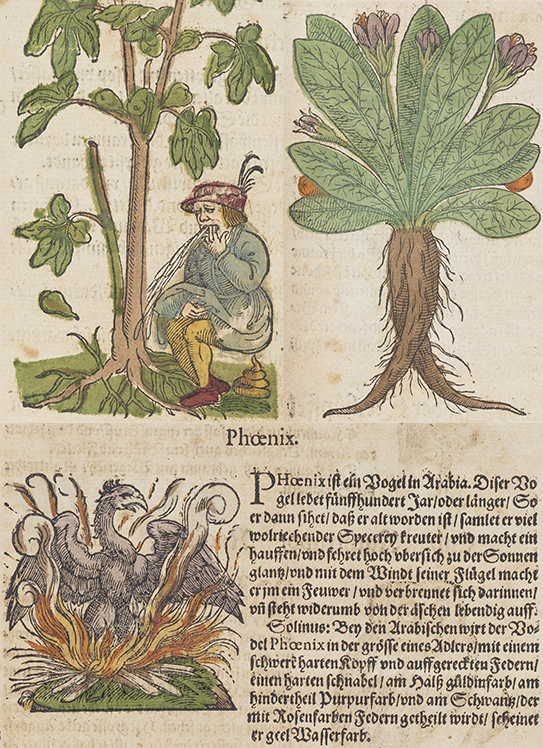
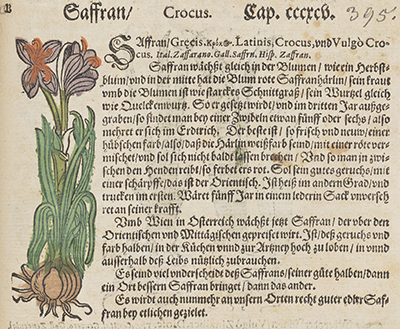
The most striking features of this book are its hundreds of hand-colored woodcuts. As one can imagine, coloring in each image is an intensive task and would have greatly increased the cost of the book. Because of this, many existing early printed herbals are found unpainted. The book was rebound at an unknown point in the 20th century with a soft, milky vellum (calfskin parchment) over pasteboard (sheets of paper pasted together to create a stiff board). The spine titling consists of black and red leather labels with gold tooling. These contrast nicely with the lighter cover.
The book also has excellent examples of conservation work, including the application of a thin, strong Japanese paper on the outer margin of the first leaf. This part of the leaf has been heavily used and is now damaged and brittle. The application of the paper support strengthens the edge and lessens the chance of further damage. This same paper was also to repair the inner margin between a few other leaves. The text block shows the staining, wear, and foxing (oxidation of iron particles in the paper) one would expect from a book of this age but is still in great condition. With proper care, it will have a happy, long life here at the John Martin Rare Book Room!
For more on Lonicer and other Herbals, check out the U. S. National Library of Medicine and the Edward Worth Library in Dublin.
If you or your group are interested in seeing this or other items mentioned in our newsletters, please contact Damien Ihrig at damien-ihrig@uiowa.edu to arrange a visit in person (one person) or over Zoom (one or more people). |
|
|
|