| March Morgagni Miscellanea | Damien Ihrig, MA, MLIS
Curator, John Martin Rare Book Room
 Greetings, friends, and happy March! Greetings, friends, and happy March!
Spring is in the air (in the northern hemisphere, anyway) and that means it is time to hear from our resident book doctor, University Libraries Collections Conservator, Beth Stone. Beth is working to clean and stabilize one of our books from Giovanni Battista Morgagni (1682-1771).
Morgagni was an 18th-century Italian anatomist and physician. He is referred to as the "father" of modern pathologic anatomy. He stressed connecting the symptoms observed in the sick to the findings from their dissection. Symptoms, he felt, were "the cry of the suffering organs." His work helped dispel the longstanding notion that most diseases were scattered throughout the body. Instead, he was able to demonstrate that they emerge from specific organs and tissues.
During his very long life, Morgagni was a prodigious worker and prolific writer. His three-volume Adversaria Anatomica (1706-1717) put him on the map. His most monumental work, De sedibus, et causis morborum per anatomen indagatis libri quinque, was published in 1761 and made him a legend among anatomists. Vast in scope, it is one of the most fundamentally important works in the history of medicine.
The book this month, however, is Morgagni's Opuscula miscellanea quorum non pauca nunc primum prodeunt, tres in partes divisa [Miscellaneous works, some of which are new, divided into three parts]. As stated in the title, this is a collection of writings on a variety of subjects, including letters to Giovanni Lancisi, an Italian physician, discussing how Cleopatra died.
Check out the Conservation Corner and more about Opuscula miscellanea below!
Stay well and happy reading!
P.S. The annual JMRBR open house is April 20, from 4-7 pm. This is our first in-person event in quite some time and we'd love to see you there!
Hours
The Room is available Monday-Thursday, 8:30-5:00 (U.S. Central) and Friday by appointment. Face masks are welcome. To guarantee the Room is available, please contact me at damien-ihrig@uiowa.edu. | | 
Beth Stone, MFA
Collections Conservator, UI Libraries
The Morgagni
When volumes arrive in conservation, the first step is a quick assessment. Often this entails physical inspection of a cart of 30-80 items, ticking off from a checklist of the most common repairs or housings we provide. When an individual item is shuffled to a technician's bench, a more thorough assessment can be completed. At first pass, I had put this item into a queue needing more intensive repair. The binding had become disengaged from the textblock, and though it looked otherwise sound, I set it aside to tackle at a future date.
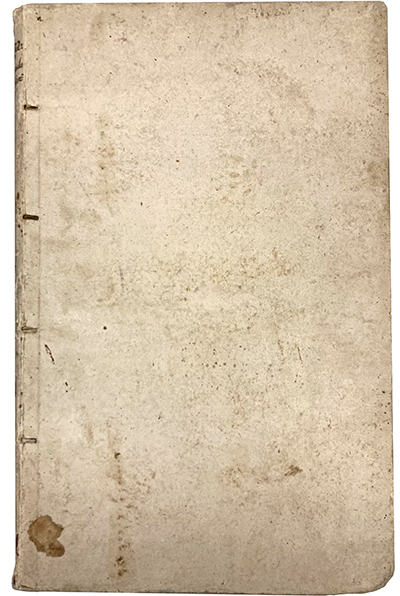
It's always delightful when an Italian paper binding comes into the lab for some treatment. They are a pleasure to hold and often have some quirks. Paper bindings were common in Italy from the early sixteenth century through the early nineteenth century. This Morgagni is an example of one of the two main types: a laced-case binding. For non-binders, this means the textblock was sewn onto alum taw (a white leather) supports, which were then laced through the single-piece heavy paper cover.
Paper bindings served two purposes; they were either placed on a textblock for temporary protection, assuming that the owner would eventually pay to have a more distinguished binding, or intended to be a less expensive final binding. It can be difficult to tell what the intention was. In this particular volume, the pages were never trimmed, and the rippling edges are the result of the deckle (wooden frame) of the paper mould (screen). These edges would have been trimmed to be flush and perhaps decorated in a different binding.
Additionally, the single-layer paper cover has no reinforcement. It remains very flexible on a book of this size while very thin and still protective. However, I think this may have originally been intended as a temporary measure rather than a final binding. The large size of the volume (10.25 in x 16.14 in) would likely require more substantial binding for handling, which would have cost a hefty sum. Additionally, the printing style seems to demand a more decorative binding.
Upon closer inspection, I noticed that the taw thongs were cleanly cut at the textblock. The thongs also remained intact on the rear cover and under the past down. Though removing a portion of the textblock resulted in a spine that was now too wide for the text that remained, no damage was present on the paper cover. Since it was paper, the cover had been able to naturally refold itself and conform to the smaller size of the spine.
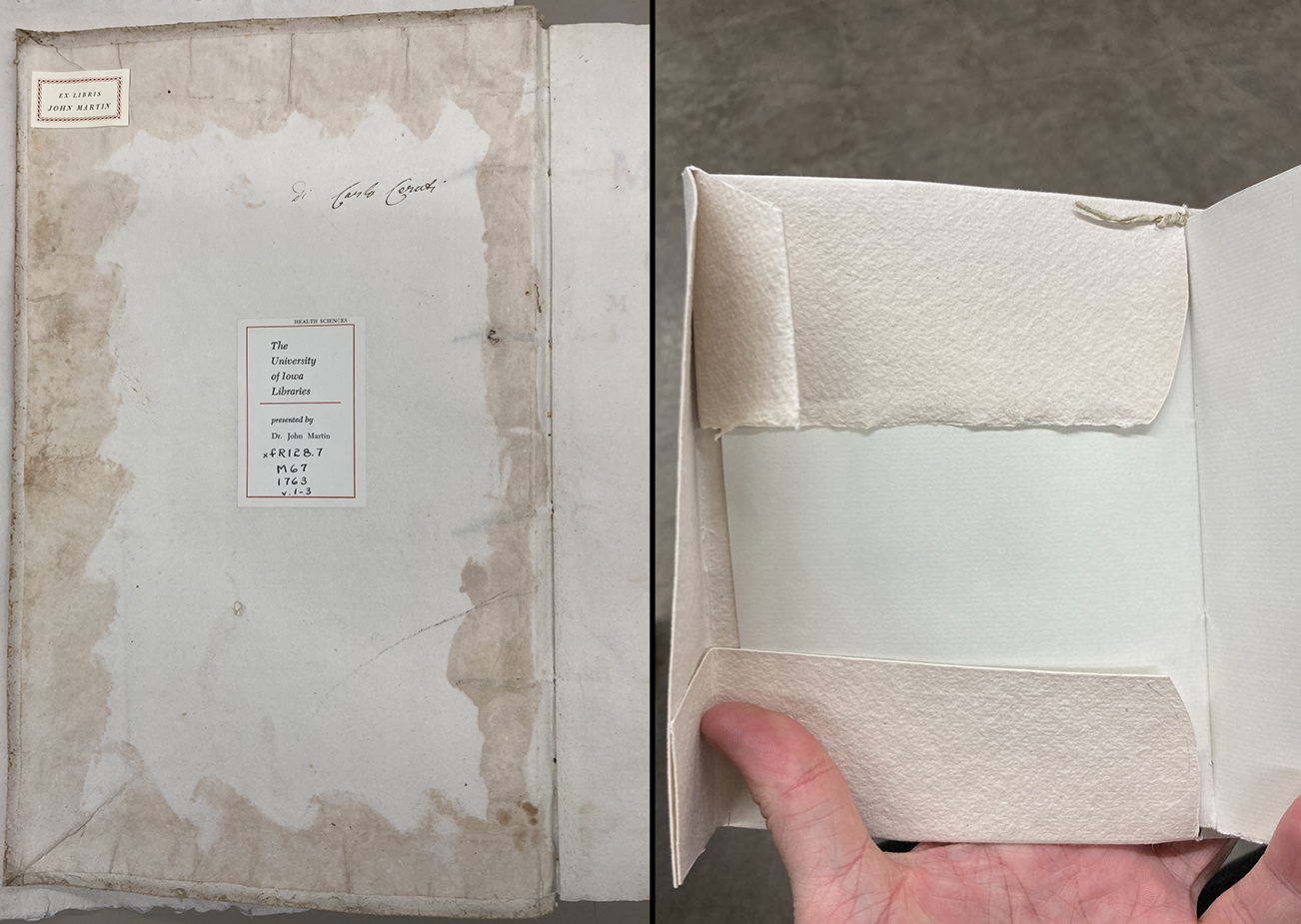
There were a handful of documents stuck in the text. Among them was a note from the purchase by Dr. Martin. It indicated that the item had been received by him, and then later by the library, in this condition.
Ultimately, this item will get custom housing and return to the collection without any intensive treatment. I will clean the cover – using specialized sponges and perhaps a gel for the stained corner – but the sewing will remain broken, and the textblock will remain disengaged
|
|
|
|
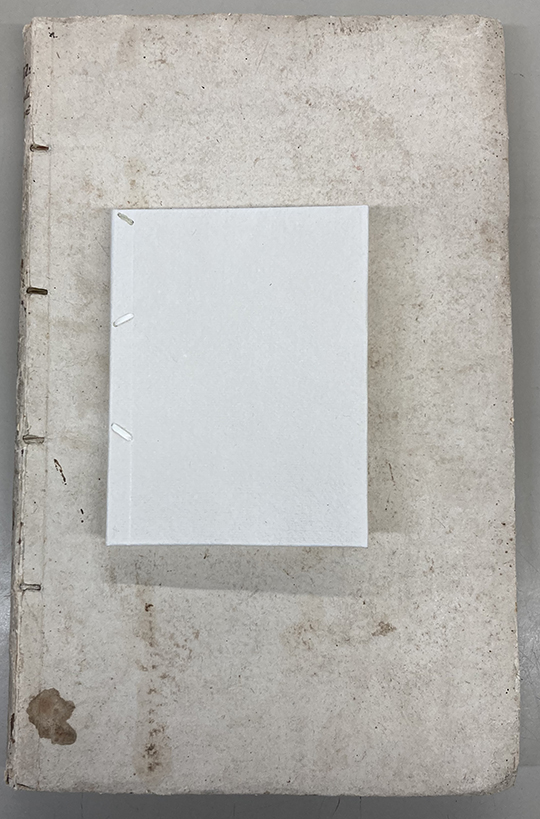
| A contemporary, small paper binding, in the style of Italian bindings. Note the difference in color – darkening from handling and storage. |
|
The cover material is folded back on itself, simply & quickly. In the Morgagni binding, this turn in is obscured by a pasted down sheet -- adhered only at the edges, as indicated by the stain. |
April 20 from 4-7 pm (central) – The John Martin Rare Book Room Open House
Join us for an evening of bibliomanic fun. Enjoy an up-close and personal look at new acquisitions and old favorites.
June 2 (time TBD) – The Roots of Medicine College of Pharmacy Medicinal Garden Grand Opening
This is an in-person event. The featured speaker is Kelly Kindscher, Ph.D., Ethnobotanist and Professor, Environmental Studies Program at the University of Kansas.
Roots of Medicine is an interdisciplinary project featuring a collaboration between the College of Pharmacy, Hardin Library for the Health Sciences, and community members. It joins the College of Pharmacy garden with historical resources from the John Martin Rare Book Room and databases from the National Institutes of Health.
 June 6 at 7 pm (central) – The John Martin Rare Book Room Presents June 6 at 7 pm (central) – The John Martin Rare Book Room Presents
The origin of viruses: from Lucy Australopithecus to King Nebuchadnezzar
Dr. Charles Grose
Professor of Pediatrics-Infectious Disease
University of Iowa Hospitals and Clinics
This is an in-person event.
| | | | MORGAGNI, GIOVANNI BATTISTA (1682-1771). Opuscula miscellanea quorum non pauca nunc primum prodeunt, tres in partes divisa [Miscellaneous works, some of which are new, divided into three parts]. Printed by Giovanni Antonio Remondini at Remondiniana, Bassano del Grappa, 1763. Three volumes bound together. 39 cm tall.
Morgagni's scholarly ability was apparent at an early age. At sixteen he was a pupil of Antonio Maria Valsalva at Bologna, and there he received the stimulus to devote his life to pathology. While pursuing postgraduate studies, he worked with Giovanni Santorini performing dissections. (Giovanni was clearly a very popular name at this time!)
By 1715 he took the chair of anatomy at Padua, a seat which he held with utmost distinction for many years. He was a brilliant and tireless investigator and, in addition to his work in medicine and anatomy, was a student of the classics and an archaeologist of repute.
Over his long career at the University of Padua, he taught thousands of students from dozens of countries. His teaching emphasized empirical | | | data, direct observation, and experimentation.
Among several other structures, his name is most widely connected with the "Columns of Morgagni," the fine, vertical folds of the anal canal.
As mentioned, if he was not teaching or dissecting, Morgagni was writing. Opuscula miscellanea shows his range and diverse interests. Along with discussing Cleopatra's cause of death, Opuscula miscellanea includes a biography of his mentor, Valsalva, a tract on gallstones, and a few more on legal issues.
As Beth stated in her piece, Opuscula miscellanea has a lovely, soft paper cover. The cover shows the effects of age, use, and exposure to the environment, with scuffs, stains, and an overall darkening. Do not let that fool you, though, as this is still an effective binding. With the new housing from Beth, Opuscula miscellanea will be around for a very long time.
Contact me to view this book or any others from this or past newsletters: damien-ihrig@uiowa.edu or 319-335-9154 to arrange a visit in person or over Zoom.
| | | |