| Graves Matters | Damien Ihrig, MA, MLIS
Curator, John Martin Rare Book Room
 Top o' the month to you, friends! As we march into spring here at Hardin, we have some great news. It is official - the fourth-floor renovation project, including the new and improved JMRBR, will finish in April! We will hold a special event this spring to help celebrate the new spaces AND the 50th birthday of Hardin Library. Top o' the month to you, friends! As we march into spring here at Hardin, we have some great news. It is official - the fourth-floor renovation project, including the new and improved JMRBR, will finish in April! We will hold a special event this spring to help celebrate the new spaces AND the 50th birthday of Hardin Library.
We interrupt this newsletter with an important announcement from Jack B. King University Librarian John Culshaw.
SAVE THE DATE: Celebrating 50 years of the Hardin Library and its fourth floor renovation
The University of Iowa Libraries invites you to celebrate 50 years of the Hardin Library for the Health Sciences and renovation of its fourth floor, including the John Martin Rare Book Room.
Open house
Thursday, May 2, from 2:30 to 4:30 p.m.
2:45–3:30 p.m.: Program featuring guest speaker Dr. Andrew Lam. The physician, historian, and award-winning author will share highlights from his new book The Masters of Medicine: Our Greatest Triumphs in the Race to Cure Humanities Deadliest Diseases.
The Hardin Library opened in May 1974 and its fourth floor improvements are made possible by a generous grant from the Roy J. Carver Charitable Trust. The JMRBR houses nearly 6,500 volumes of original works that represent classic contributions to the history of the health sciences from the 15th through the 21st centuries.
You’ll be receiving a formal invitation by email in the coming weeks. Please reach out to Damien Ihrig, curator of the John Martin Rare Book Room, or Anne Bassett, senior director of strategic communications and external relations for the Libraries, with any questions.
Look forward to seeing you there,
John
We now return you to your regularly scheduled newsletter.
Read below to learn more about the famous Irish physician Robert Graves (1796-1853) and his work.
Stay well and happy reading!
Hours
The Room is currently under renovation. Requests for materials will be considered on a case-by-case basis. For more information, please contact me at damien-ihrig@uiowa.edu or 319-335-9154 | | 
Events
Interacting with Renaissance Books: Guest Lecture with Dr. Suzanne Karr Schmidt
Event info
Tuesday, March 26, 2024 from 6:30 p.m. to 7:30 p.m. CT
University of Iowa Main Library, Shambaugh Auditorium (Virtual Option Available)
This lecture looks at the continuing life and uses of some very old books in and outside of the Making the Book, Past and Present exhibition. Starting from one of the biggest in both scale and edition size, the 1493 Nuremberg Chronicle, which was printed from hundreds of woodcut blocks, to others containing mystical puzzles or movable parts, no two copies of a pre-modern book were ever the same. This look at annotating, collecting, and censoring them, as well as keeping things in them will show just how modern they remain. Dr. Karr Schmidt's talk is part of exhibition programming for Making the Book, Past and Present. Curated by Dr. Eric Ensley and Emily Martin, the exhibit is on display in the Main Library Gallery at the University of Iowa Libraries through June 28, 2024.
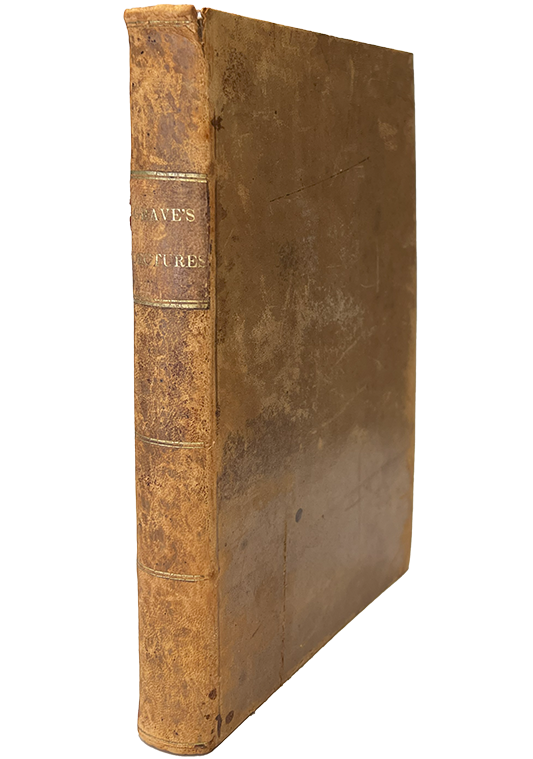
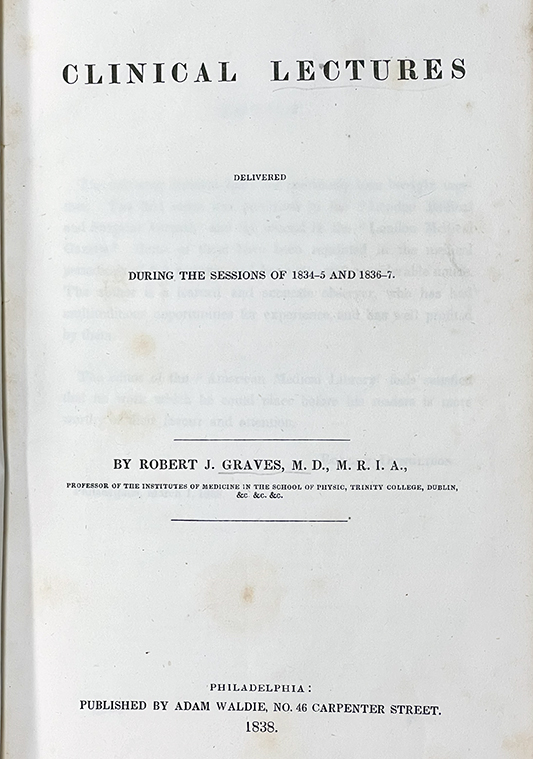
| | | | GRAVES, ROBERT JAMES (1796-1853). Clinical lectures delivered during the sessions of 1834-5 and 1836-7. Printed in Philadelphia by Adam Waldie, 1838. 23 cm tall.
Robert Graves was a renowned Irish physician and medical educator who made significant contributions to the field of endocrinology, clinical teaching, and patient care. He is most famous for describing the condition that bears his name, Graves’ disease, which is characterized by an overactive thyroid gland, protruding eyes, and various effects on the mood and energy levels of the patients.
He was the first to recognize the link between these symptoms in 1835, although he was not the first to observe them. His work was later acknowledged by the French physician Armand Trousseau, who named the disease after him.
Graves, a charismatic and unconventional personality, was born in 1796 in Dublin, Ireland, to a wealthy and influential family of Anglo-Irish origin. He studied medicine at Trinity College Dublin and graduated in 1818. He then traveled to Europe and visited several medical schools in France, Germany, and Italy, where he learned from the leading physicians of the time and witnessed the latest innovations in medical practice and education. He was impressed by the use of the stethoscope, which had been invented by René Laennec in France in 1816, and the method of bedside teaching, which allowed students to interact with patients and learn from their cases.
Graves returned to Ireland in 1821 and became the chief physician and lecturer at Meath Hospital in Dublin. He introduced many reforms and improvements to the medical curriculum and patient care at the hospital. He was one of the first to lecture in English instead of Latin, making the subject more accessible and engaging to the students. He also adopted the bedside teaching method, which he had seen in France and Germany, and encouraged the students to observe, question, and assist the patients and the doctors.
He promoted new methods for practicing medicine, including the use of the stethoscope. And you can thank Graves for the second hand on your watch. Looking for a better way to measure the pulse rate of his patients, he designed a new watch hand that would track seconds instead of minutes. He never patented the design, though, and the watchmakers he | | | worked with had no second thoughts – they began selling watches with this well-timed innovation soon after his death.
Graves was a prolific writer and speaker who published many of his clinical lectures and observations in various medical journals and books. As good of a clinician as he was, he was an even better teacher. Graves' lectures were widely read and admired by his peers and students and were translated into several languages. He was praised as "the first great medical teacher we have had in this country" by the Dublin University Magazine in 1842 and as "a new light" in the medical field.
He founded the Park Street School of Medicine in Dublin, where he continued to teach and practice until his death from liver cancer in 1853. He was a pioneer of clinical teaching and patient care who introduced many innovations and discoveries to the medical world. He was especially known for his approach to treating fevers, which he advocated to "feed" instead of starve. So proud was he of this that he insisted the epitaph on his gravestone should read "He fed fevers."
Clinical lectures consists of lectures given by Graves between 1834 and 1837. The lectures, published in British journals, were collected and published in this single volume by Robert Dunglison, a famous Anglo-American physician and great admirer of Graves. Devoid of illustrations, the lectures cover a wide variety of illnesses and ailments and their treatments.
Our copy is in great condition. The soft calfskin clover cover shows some effects of its age, especially at the top headband, where people reflexively use a finger or two to tip a book when grabbing it off a shelf. You'll be happy to know this practice is outlawed at special collections such as the JMRBR!
The only thing that outshines the condition of the cover is that of the paper inside. The paper shows some minor foxing here and there, but overall it is bright and sounds great when leafing through it. Good news considering the industrialization of papermaking was just starting to take off at this time, with the overall quality of paper suffering for nearly a century.
Contact me to take a look at this book or any others from this or past newsletters: damien-ihrig@uiowa.edu or 319-335-9154. | | | |