| Dutch courage | Damien Ihrig, MA, MLIS
Curator, John Martin Rare Book Room
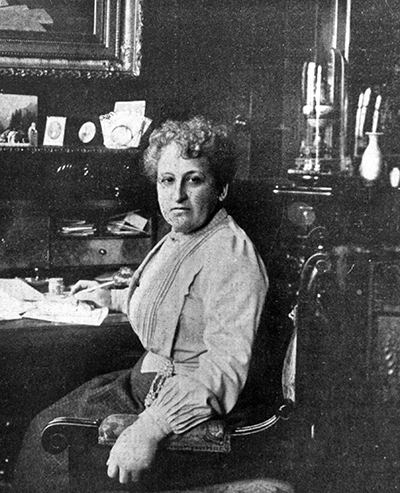 Happy March, friends. This Women's History Month, I highlight a book from the pioneering 19th-century Dutch physician and activist Aletta Jacobs. Born in 1854 in the Netherlands, Jacobs chafed at the status quo and the limited educational opportunities for women in the Netherlands. She rejected the standard for Dutch girls at the time, "finishing school," and instead studied at home with her parents. Happy March, friends. This Women's History Month, I highlight a book from the pioneering 19th-century Dutch physician and activist Aletta Jacobs. Born in 1854 in the Netherlands, Jacobs chafed at the status quo and the limited educational opportunities for women in the Netherlands. She rejected the standard for Dutch girls at the time, "finishing school," and instead studied at home with her parents.
From a young age, Jacobs was determined to pursue her dream of becoming a doctor like her father. At the time, though, women were barred from higher education. To become a doctor meant that she would have to achieve many firsts for the Netherlands. Jacobs was undeterred and said, "Hold my Heineken."
She first earned a diploma in pharmacy in 1869. She requested admission to the University of Groningen through a letter-writing campaign by herself and her father. She was finally told to continue her studies for two more years to prepare for the entrance exam. Through this provisional admission, she was able to convince a local high school to allow her to attend classes, becoming the first Dutch woman to attend secondary school.
In 1871, she caught wind of a male student granted admission to the University of Groningen based on his pharmacy diploma. She was granted approval to attend and became the first woman to enroll at the University of Groningen. Despite challenges and resistance from male students and professors, she graduated in 1879, earning her medical degree.
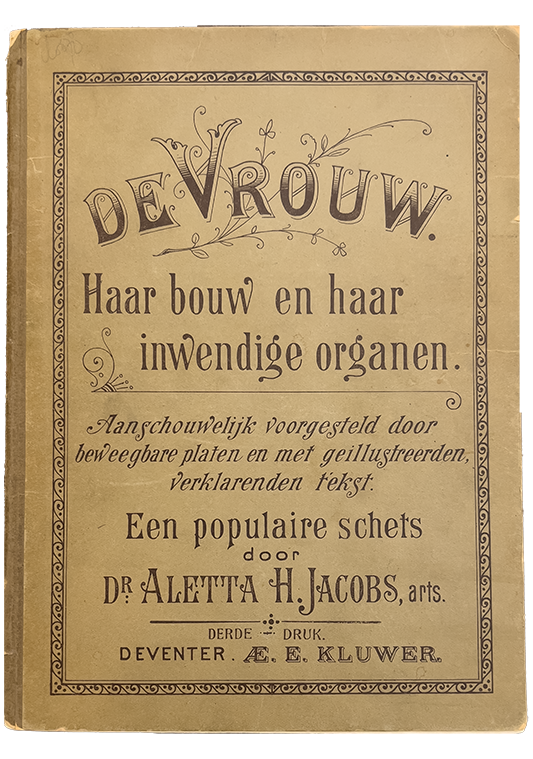
Throughout her career, she was a forceful supporter of social reforms. She was an unyielding advocate for the health of women and children as well as suffrage and international peace. She wrote many articles and books, including De Vrouw: Haar bouw en haar inwendige organen [The Woman: Her physique and her internal organs], a short book about female anatomy.
Read below to learn more about this pioneer in medicine and our copy of De Vrouw.
Stay well and happy reading!
Hours
The JMRBR is open to the public from 8:30 a.m. to 5 p.m. Monday through Thursday and by appointment on Friday. For more information, please contact me at damien-ihrig@uiowa.edu or 319-335-9154. | | 
Events
 Meet the Sackners (and the Symbolists) Meet the Sackners (and the Symbolists)
Wednesday, March 5, from 12 to 1 p.m.
Main Library Gallery
Register here
Join the curator of A Roll of the Dice: Symbolism in the Sackner Archive for a behind-the-scenes look at his spring 2025 Main Library Gallery exhibition. Learn more about Ruth and Marvin Sackner, the self-taught archivists who created the world’s largest collection of word art, which they donated to the University of Iowa Libraries in 2019. Find out how "A Roll of the Dice will Never Abolish Chance" by Stéphane Mallarmé helped break down the boundaries between visual art, poetry, and music, and what drew the Sackners to works inspired by this iconic 19th-century French Symbolist poem.
Rich Dana is the project coordinator librarian for the Ruth and Marvin Sackner Archive of Concrete and Visual Poetry at the University of Iowa Libraries. He currently teaches classes at the Center for Book Arts in New York City and is an adjunct instructor at the University of Iowa Center for the Book. In addition, he is a copier artist and the author of Cheap Copies!: The Obsolete Press Guide to DIY Mimeography, Hectography and Spirit Duplication.
Individuals with disabilities are encouraged to attend all University of Iowa–sponsored events. If you are a person with a disability who requires a reasonable accommodation in order to participate in this program, please contact Main Library Gallery in advance at 319-467-1805 or lib-gallery@uiowa.edu.
 Open House for the John Martin Rare Book Room Open House for the John Martin Rare Book Room
Thursday, April 24, from 5:30 to 8 p.m.
John Martin Rare Book Room
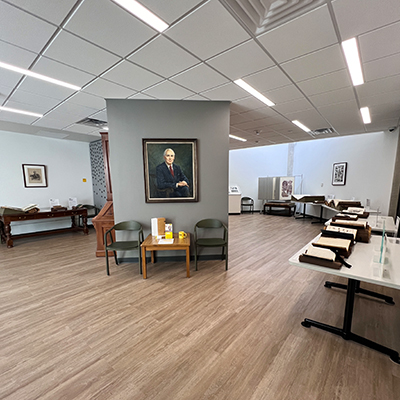
The annual John Martin Rare Book Room (JMRBR) open house will be on Thursday, April 24, 2025. All are invited to drop in from 5:30–8 p.m. to tour the space and explore staples of the JMRBR collection. There will also be special materials on display, such as John Gerard’s The herball and Hieronymus Brunschwig’s A most excellent and perfecte homish apothecarye, that will highlight historical examples of medicinal recipes, apothecaries, home remedies, poisons, and herbal medicine.
Individuals with disabilities are encouraged to attend all University of Iowa–sponsored events. If you are a person with a disability who requires a reasonable accommodation in order to participate in this program, please contact Damien Ihrig in advance at 319-335-9154 or damien-ihrig@uiowa.edu.
| | | | JACOBS, ALETTA (1854-1929). De vrouw: haar bouw en haar inwendige organen [The Woman: Her physique and her internal organs]. Printed in Deventer by Ebele E. Kluwer, 1900. 26 cm tall.
After completing her studies, Jacobs opened a medical practice in Amsterdam. She focused on women’s health, providing care, and advocating for women’s rights. Jacobs was a pioneer in promoting birth control and reproductive health, believing that women should have control over their own bodies. She also worked tirelessly to improve the education and health of women and children.
Throughout her life, Jacobs worked to improve the conditions of women and children in various sectors. She campaigned for better working conditions for women, particularly in retail, and was instrumental in establishing laws that protected workers’ rights. Her advocacy extended to public health, where she pushed for reforms that would benefit the most vulnerable populations.
In addition to her medical practice, Jacobs was an active member of various women’s rights organizations. She traveled extensively, speaking about women’s health issues and the importance of education for women. Her efforts helped to change public perceptions about women’s roles in society. She advocated for the deregulation of prostitution and improved working conditions for women, believing in the need for safe and informed choices regarding their bodies.
In 1882, Jacobs founded the world’s first birth control clinic in Amsterdam. She believed that women should have control over their reproductive health. Her clinic provided education and resources about contraception, which was a revolutionary idea at the time. Not content with the birth control options for women at the time, she created and tested a new diaphragm. Establishing its effectiveness, it became a popular birth control choice for women and eventually was known throughout the English-speaking world as the Dutch Cap.
Jacobs was a strong supporter of women’s right to vote. She began her campaign for suffrage in 1883, challenging the legal barriers that prevented women from participating in politics. | | | Her efforts contributed significantly to the eventual success of the women’s suffrage movement in the Netherlands, culminating in women gaining the right to vote in 1919.
Jacobs was also involved in international peace movements. She participated in international conferences aimed at promoting peace and disarmament, believing that women’s voices were crucial in these discussions. She argued that women had a unique perspective on peace and should be included in decision-making processes.
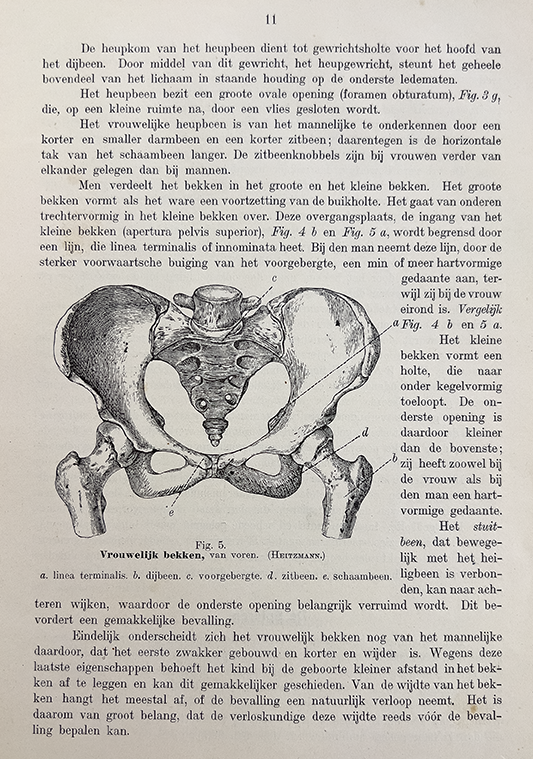
De vrouw was written to offer a more thorough and accurate understanding of the female body, highlighting both external features and internal organs through detailed illustrations and explanatory text. It focuses on women's anatomy, especially the structure and function of the female reproductive system, addressing the significant knowledge gap many women had about their own bodies.
De vrouw begins with a foreword by Jacobs, who expressed concern over the widespread ignorance about women's bodies, even among the educated. Jacobs aimed to provide a concise and accessible resource to satisfy the public's curiosity and need for information.
The text aimed to deliver clear descriptions supported by illustrations, stressing the importance of understanding both the general framework of human anatomy and the specific details of female organs. This introduction sets the stage for a detailed exploration of human anatomical structures, emphasizing the need for better education on the subject.
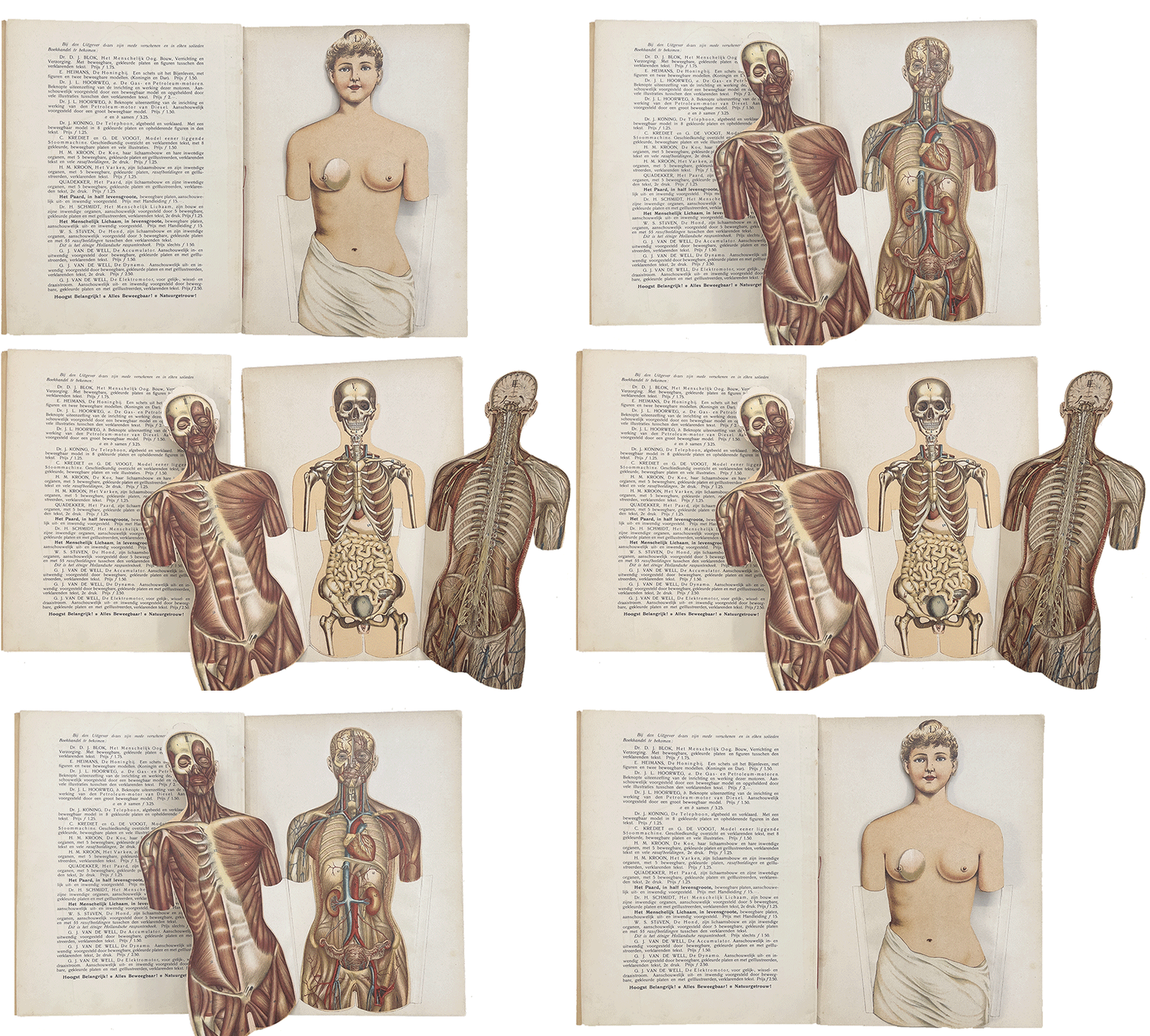
The book is slim in form, with the text block snuggled between two stiff paper boards. The whole thing is held together with a pamphlet-type stitch with a lovely and vibrant red thread. It is chock full of illustrations, including a thorough flap illustration shown in the banner image above! Our copy is in stable condition, although, as can also be seen in the banner image above, the back cover has separated.
Contact me to take a look at this book or any others from this or past newsletters: damien-ihrig@uiowa.edu or 319-335-9154. | | | |