| Life in the Sick-Room | Damien Ihrig, MA, MLIS
Curator, John Martin Rare Book Room
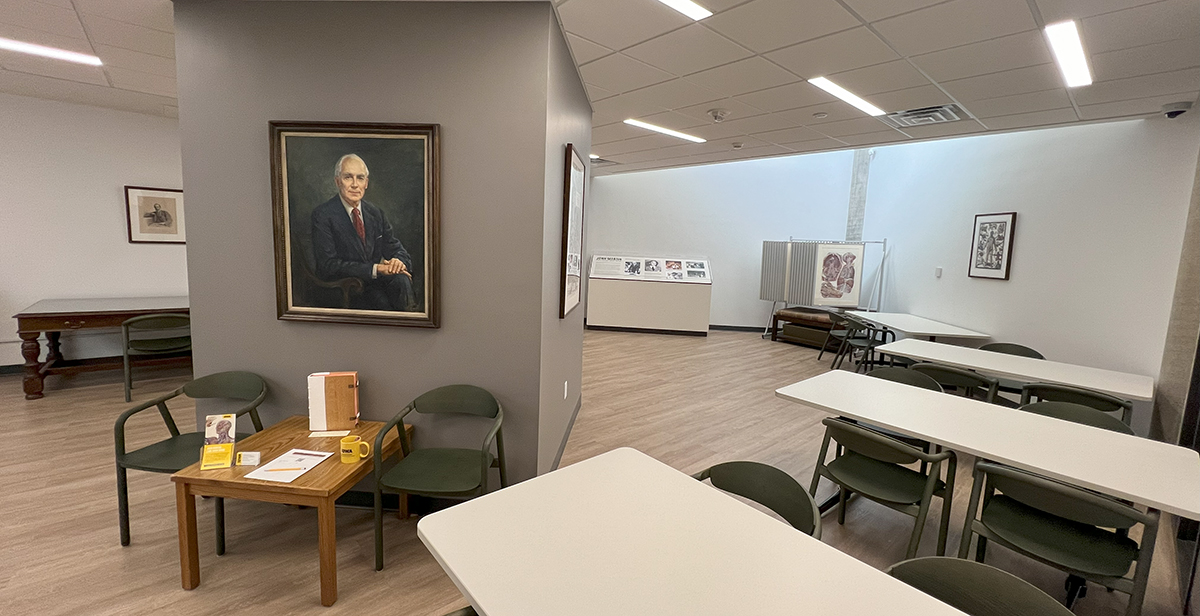
 Thanks to all who helped us celebrate the 50th anniversary of Hardin Library and the renovation of the fourth floor, including the John Martin Rare Book Room. The Room looks fantastic and the celebration was off the hook, as I'm sure the youths still say. Thanks to all who helped us celebrate the 50th anniversary of Hardin Library and the renovation of the fourth floor, including the John Martin Rare Book Room. The Room looks fantastic and the celebration was off the hook, as I'm sure the youths still say.
Jack B. King University Librarian John Culshaw and Hardin Library Director Janna Lawrence em-ceed, while former longtime Hardin employee and curator of the JMRBR Ed Holtum delighted the crowd with stories from Hardin Library's past. Featured speaker Dr. Andrew Lam stole the show, sharing funny and poignant stories from his book, The Masters of Medicine.
From all of us at Hardin and the UI Libraries, thank you for your support. We look forward to celebrating again in 2074!
This month, we highlight the extraordinary life and work of Harriett Martineau, a British author, journalist, influential novelist, and one-person publishing powerhouse. Martineau is often credited as being the first female sociologist. She published books and essays on sociological, holistic, religious, and domestic topics and was able to support herself financially through her writing, a rare feat in the Victorian era.
Princess (later queen) Victoria enjoyed Martineau's writings and invited her to her coronation in 1838. She was acquainted with many other famous figures of the era, including Thomas Malthus, John Stuart Mill, George Eliot, Elizabeth Barrett Browning, Florence Nightingale, and Charlotte Bronte. She was a fan of Charles Darwin and was acquainted with his brother, Erasmus, who sent her a copy of On the origin of species when it was published in 1859.
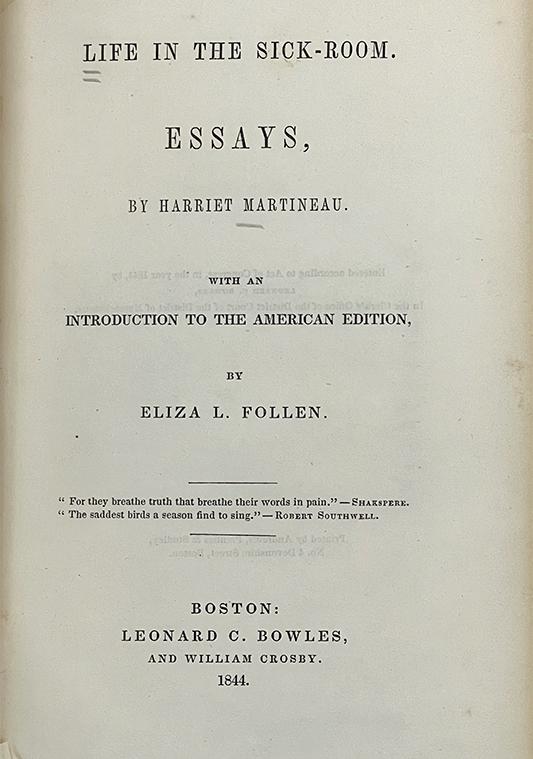
Life in the sick-room is an autobiographical work about being homebound and a declaration of independence and self-reliance. Although originally published anonymously, most folks reading it at the time would have known it was written by Martineau. Subsequent editions, such as our first American edition, include her as the author. It asserts the place of the patient in the patient/doctor relationship—something that critics of the time were not comfortable hearing, especially from a woman.
Read below to learn more about Harriett Martineau and her Life in the sick-room. For more detailed biographies of Martineau, please visit the Martineau Society and Smithsonian Magazine.
Stay well and happy reading!
Hours
The JMRBR is open to the public from 8:30 a.m. to 5:00 p.m. Monday through Thursday and by appointment on Friday. For more information, please contact me at damien-ihrig@uiowa.edu or 319-335-9154. | | 
Events
 UI Libraries Main Gallery: Making the Book, Past and Present UI Libraries Main Gallery: Making the Book, Past and Present
Event info
Ongoing through June 28
University of Iowa Main Library Gallery
If you haven't had a chance yet, stop and see this amazing exhibit curated by Eric Ensley, curator of rare books and maps in the UI Libraries Special Collections and Archives, and Emily Martin, adjunct assistant professor in bookbinding and book arts at the UI Center for the Book. The exhibit explores the intersections of history, art, and practicality. What can we learn by placing books, materials, and makers from the Middle Ages through today in conversation with one another?
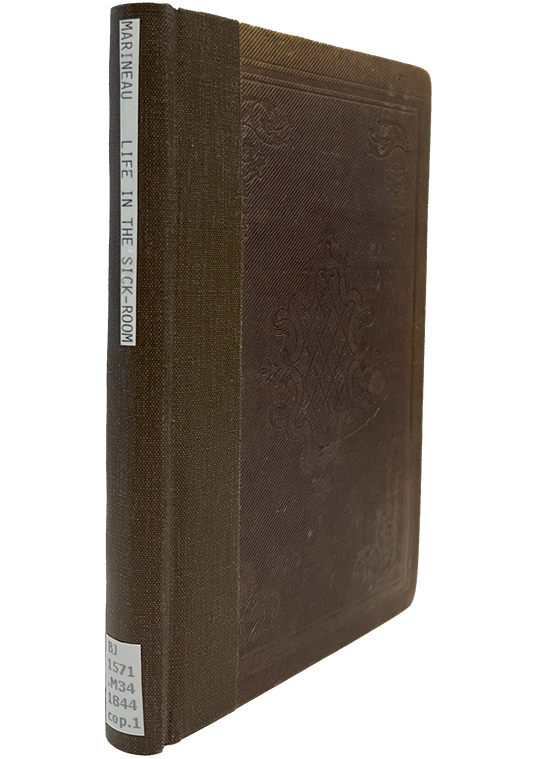
| | | | MARTINEAU, HARRIETT (1802-1876). Life in the sick-room: Essays. Printed in Boston by L.C. Bowles and W. Crosby, 1844. 20 cm tall.
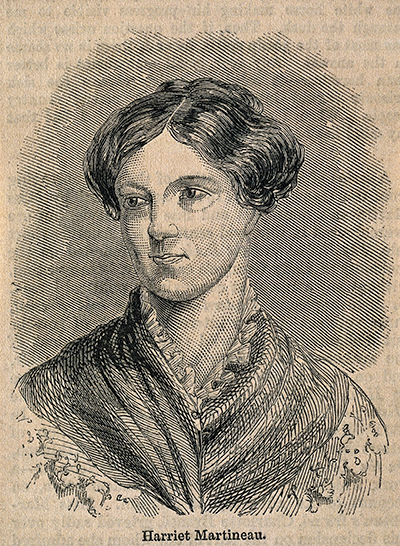 Martineau was born in 1802 into a progressive Unitarian family in Norwich. Despite the societal expectations that confined her to domestic roles, Harriet's intellect and determination were undeniable. In 1823, she challenged gender norms by anonymously publishing On female education, advocating for women's rights to education and intellectual pursuits. Martineau was born in 1802 into a progressive Unitarian family in Norwich. Despite the societal expectations that confined her to domestic roles, Harriet's intellect and determination were undeniable. In 1823, she challenged gender norms by anonymously publishing On female education, advocating for women's rights to education and intellectual pursuits.
Her literary breakthrough came with the publication of Illustrations of political economy in 1832, a series of short stories that deftly wove economic theories into narratives about everyday people. This work not only brought her fame and financial security but also highlighted her as a significant intellectual force.
From 1834 to 1836, Martineau traveled across the United States. A staunch abolitionist and advocate for women's rights, she wrote extensively against slavery and the lack of opportunities for women, eventually writing Society in America. Her extensive travels also led to insightful writings on the Middle East, India, and Ireland, further establishing her as a versatile and influential journalist and author.
Martineau began experiencing a series of symptoms while on her travels and, in 1839, returned to England for treatment. For someone experiencing a debilitating illness but not necessarily dying, being confined to a "sick room" was common at this time. It allowed the room to be set to the orders of the physician and made it easier for the family to care for their ill relative.
Although confined to her own sick room for five years, Martineau was financially secure and had a progressive, independent spirit. She oversaw her medical care and constructed an environment that best suited her needs. She even restricted access from her family, who she felt could be more emotionally draining than helpful. While resting and recuperating, Martineau remained very productive, writing a novel for children and the essays eventually published in Life in the sick-room.
Already considered an irritation in the medical community, she really caused a stir by claiming that Mesmerism, a pseudo-science medical treatment, cured her. Franz Anton Mesmer (1734-1815), a German physician, maintained that an "animal magnetism" pervades the universe and exists in every living thing. | | | He believed that its transmission from one person to another could cure various nervous disorders through its healing properties. Mesmer at first used magnets, electrodes, and other devices to effect his cures, but after arousing suspicion among his fellow physicians, he preferred to utilize his hands.
Considered quackery by many in the medical establishment, even in 1844—including by her physician brother-in-law who oversaw her care—physicians publicly attacked Martineau's claims about Mesmerism. Her brother-in-law eventually published a detailed account of her illness. Although he promised it would anonymously appear in a medical journal, he instead created a public pamphlet and made little effort to disguise who he was talking about.
After ten years of good health, Martineau once again fell ill in 1855 and returned to her sick room. She remained there until her death in 1876. She continued to write during this time, completing, among other things, her autobiography, works promoting women's suffrage, and critiques of the Contagious Diseases Acts, which targeted women in the name of preventing sexually transmitted illnesses.
After her death, the medical establishment, again including her brother-in-law, who publicly published the results of an unauthorized autopsy, went out of their way to discredit Martineau and her work. Without evidence, they claimed her illness led her to behave in unconventional and "unfeminine" ways. Martineau remained an inspiration to many, though, and her works live on as a testament to her resilience and rejection of the status quo.
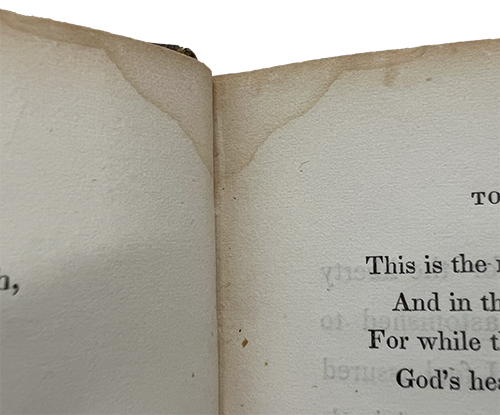
Our copy of the first American edition of Life in the sick-room is quite unassuming. It features a standard 19th-century burgundy cloth cover that has faded over time. Since it was a book in the library's circulating collection for most of its life, it features a "library cloth" rebacked spine with the label maker-printed call number and title easily visible. Inside, the paper is in good condition, with evidence of damage from a long-ago liquid spill. Much like Martineau herself, though, this little book has shown great resilience in the face of adversity!
Contact me to take a look at this book or any others from this or past newsletters: damien-ihrig@uiowa.edu or 319-335-9154. | | | |