| Under the Covers: Durante | Damien Ihrig, MA, MLIS
Curator, John Martin Rare Book Room
 Happy November, everyone. As our brief Iowa autumn comes to a close, it's an exciting time at the JMRBR. The renovation of the fourth floor continues (mostly) on schedule and construction on the new JMRBR reading room will soon begin in earnest. I look forward to seeing the project progress through the winter and will share pictures in future newsletters! Happy November, everyone. As our brief Iowa autumn comes to a close, it's an exciting time at the JMRBR. The renovation of the fourth floor continues (mostly) on schedule and construction on the new JMRBR reading room will soon begin in earnest. I look forward to seeing the project progress through the winter and will share pictures in future newsletters!
This issue is the second of a series looking more closely at some of our items with binder's waste. As mentioned in a previous newsletter, I was part of a small team that presented at the June 2023 Rare Books and Manuscripts Section (RBMS) conference. Our presentation focused on the Iowa Initiative for Scientific Imaging and Conservation of Cultural Artifacts (IISICCA) and the involvement of the JMRBR. For more on the project and its scanning techniques, see the IISICCA group's article in Heritage Science.
This month’s book is Herbario nuovo [The new herbal] by Castore Durante (aka Castor Durante da Gualdo, 1529-1590). Durante, a literal Renaissance Man, was a 16th-century Italian physician, botanist, and poet.
Durante was born in Gualdo Tadino in the province of Perugia in 1529 into a family of six. Durante and his siblings grew up in a household filled with books and intellectual conversation. Throw in the occasional card game, and that is my kind of home!
A bit of a late bloomer, Durante's scholarly career took off with the publication of De bonitate et vitio alimentorum centuria [On the benefits and vices of one hundred foods] in 1565, a comprehensive work exploring the properties of a hundred plants and other foodstuffs. Think of it as a sort of Renaissance foodie guide focused on health.
Durante dabbled in literature, too. He published an eighth-rhyme version of the sixth book of Vergil's Aeneid in 1566. He also founded the Romiti Academy in Gualdo. This group of scholars undertook various literary projects, including theological treatises and a collection of rhymes with the catchy title The New Temple of Apollo.
Read below to find out more about Durante and to see under the covers of this fascinating Renaissance herbal.
Stay well and happy reading!
Hours
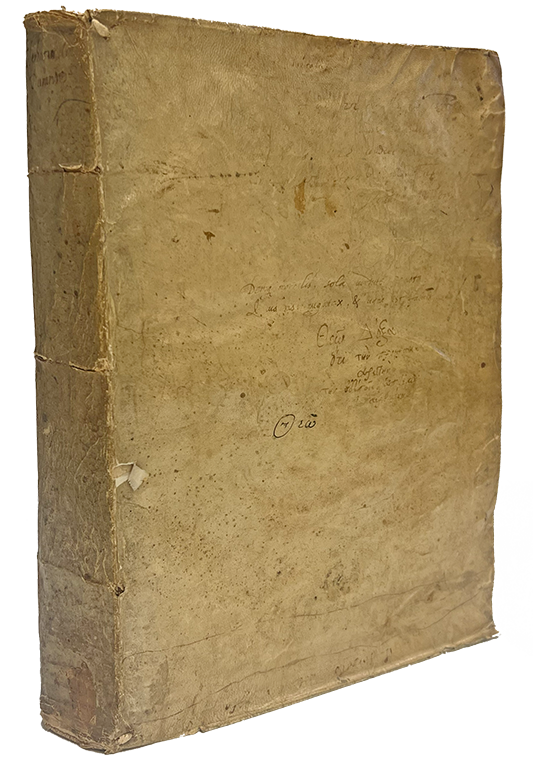
The Room is currently under renovation. Requests for materials will be considered on a case-by-case basis. For more information, please contact me at damien-ihrig@uiowa.edu or 319-335-9154 | | | | DURANTE, CASTORE (1529-1590). Herbario nuovo [The new herbal]. Printed in Rome by Bartholomeo Bonfadino & Tito Diani, 1585. 33 cm tall.
With an interest in the natural world, Durante pursued medicine as a career. After completing his medical studies at the University of Perugia in 1567, Durante began practicing in his hometown. After a short stint in Gualdo, Durante relocated to Viterbo, Italy, around 1568. It was here that he grew his interest in materia medica and botany.
As Durante’s reputation grew as a physician, botanist, and good Catholic, he eventually caught the eye of the powerful Cardinal Girolamo Rusticucci (Durante dedicated a few of his books to Rusticucci and the others to his provincial cardinal). On recommendation from Rusticucci, Durante became the chief physician at the court of Pope Sixtus V (equally revered and reviled for his hardline approach to public safety and reconstruction throughout the Papal States).
Durante simultaneously became professor and chair of botany at the University of Rome. He maintained his interest in materia medica and lectured on simples along with botany. After many successful years as a professor and lecturer, he left Rome and retired to Viterbo, where he died in 1590.
Durante published two important works that built upon the foundation of his early work on materia medica, Herbario nuovo and Il Tesoro della sanita [The treasure of health] (1586), an Italian vernacular update of Centuria. A copy of the 1611 and 1640 printings of Il Tesoro can be found in the UI Libraries Special Collections Szathmary Collection.
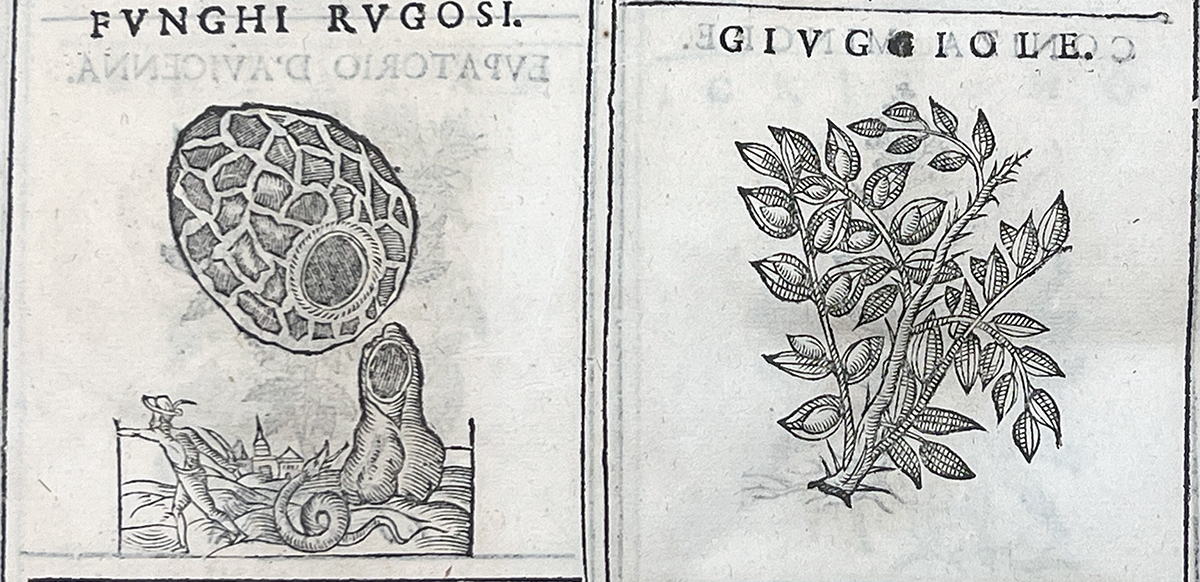
Durante considered Herbario nuovo an update of Mattioli's work, which itself was an update of Dioscorides. He used a familiar structure to describe each plant. Species were introduced with woodcut illustrations and by common names as well as their names in Greek, Latin, Italian, German, French, Spanish, and others. This was followed by descriptions of where the plants can be found, different forms they may take in their growth cycle, and their "virtues" - medicinal qualities and how they might be used to treat various illnesses. Other than describing a few new (to Europe) species (e.g., tobacco), Herbario is essentially a rehash of Mattioli, Dioscorides,
| | | and others.
What got folks excited about herbals like Durante's, though, were the illustrations, and Herbario has almost a thousand. Borrowing heavily from Fuch's De histroia stirpium, the images were created by the husband and wife woodcut/engraving team of Leonardo and Isabella Parasole. Their illustrations helped cement Herbario as a popular resource and ensured that it was reprinted many times during the two centuries after it was first published.
Our copy of Herbario is covered in a soft and flexible limp vellum. There is marginalia throughout, including on the cover. As we've seen from earlier newsletters, some herbals were painted. Interestingly, our Herbario is almost entirely unpainted - except for one plant. Only the first plant listed, an evergreen tree, was colored in. I can imagine the artist painted one and was exhausted at the thought of doing another 900 or so!
The reason it was chosen for the IISICCA project, though, was not its nifty illustrations or minimalist paint job but rather for what was buried under its cover. And what a fun surprise it was to find manuscript music notation lining the spine and providing support for the covers! Was the parchment music sheet damaged? Was it just practice notation? Was the binder not a fan of the music? Perhaps just a coincidence, but the printers, Bonfadino and Diani were known for printing music. Did the parchment sheets come from them? For whatever reason, the binder felt the parchment was expendable. Their loss is our gain, their trash our treasure. For those of you who are musically inclined (whereas I am musically declined), here's your shot to Name That Medieval Tune.
The images above were obtained using a soft backlight illuminating the bits of manuscript through the vellum cover. Knowing the waste is there meant Herbario was an excellent candidate to help calibrate the two CT scanners used for the project. The books scanned for IISICCA are still being processed, but we are excited to see what other surprises await under their covers.
Contact me to take a look at this book or any others from this or past newsletters: damien-ihrig@uiowa.edu or 319-335-9154. | | | |